
Anti-Aging
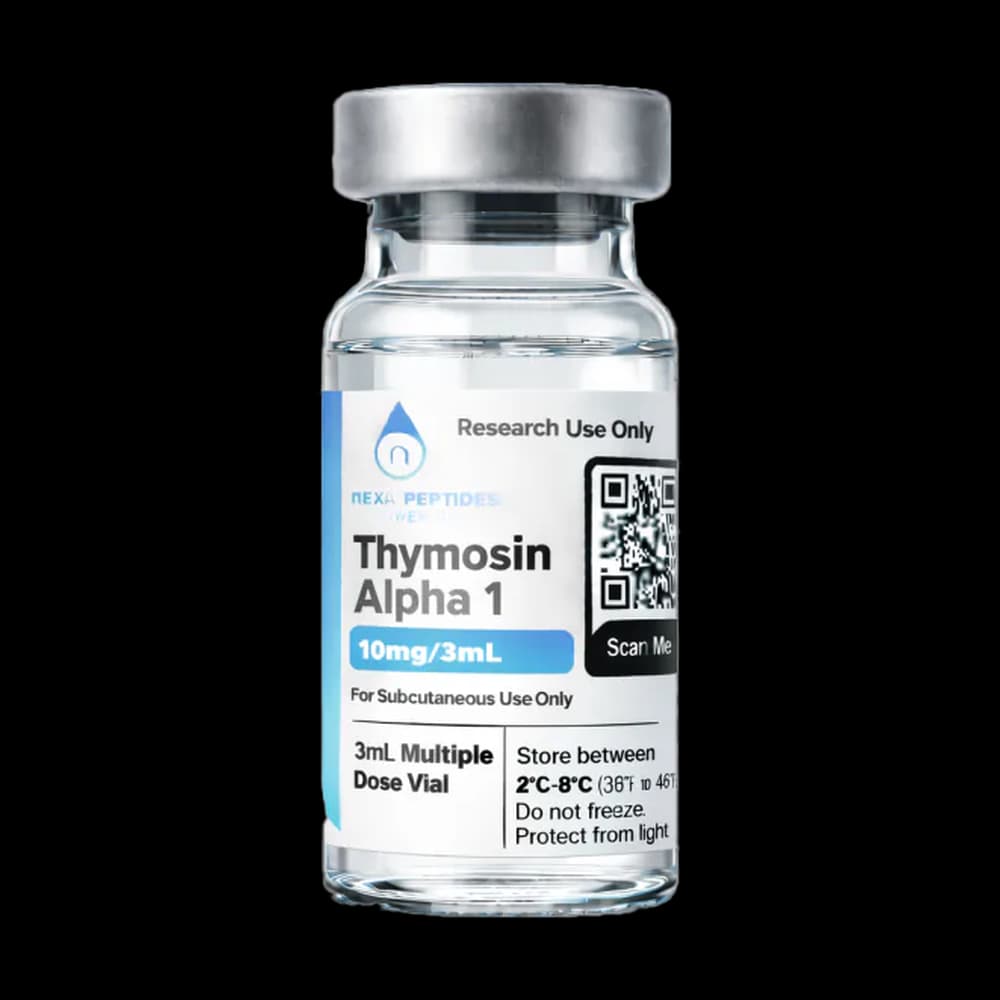
Thymosin Alpha-1 — 10mg
SKU: NXP-TA1-10
Immune-boosting peptide that enhances immune response, reduces inflammation, and supports antiviral defense and immune regulation. For research use only.
Product Details
Thymosin Alpha-1 (Ta1) is a 28-amino-acid peptide naturally produced by the thymus gland, playing a central role in immune system maturation and regulation. This 10mg research-grade lyophilized preparation supports laboratory investigations into innate and adaptive immune response modulation, dendritic cell maturation, and T-cell differentiation pathways.
Published research has explored Thymosin Alpha-1 in the context of toll-like receptor signaling, natural killer cell activation, MHC class I antigen presentation, and cytokine profile modulation. Studies have examined its effects on Th1/Th2 balance, regulatory T-cell function, and immune reconstitution in immunocompromised models.
Each vial is manufactured under cGMP-adjacent conditions with HPLC purity exceeding 98% and mass spectrometry verification of the full amino acid sequence. Tested for endotoxin levels, sterility, and peptide content. Certificate of analysis available for each production lot.
Store lyophilized at -20°C. Reconstituted at 2-8°C, use within 60 days. Avoid repeated freeze-thaw cycles to maintain peptide integrity.
For research and laboratory use only.
About Thymosin Alpha-1
Thymosin Alpha-1 is a highly conserved acidic peptide that represents a key component of the thymosin fraction 5, originally isolated from bovine thymus tissue. It is an N-terminally acetylated polypeptide consisting of 28 amino acids with the sequence Ac-Ser-Asp-Ala-Ala-Val-Asp-Thr-Ser-Ser-Glu-Ile-Thr-Thr-Lys-Asp-Leu-Lys-Glu-Lys-Lys-Glu-Val-Val-Glu-Glu-Ala-Glu-Asn-OH and a molecular weight of approximately 3108.3 g/mol. As a naturally occurring thymic peptide, it is recognized as a primary mediator of the immunomodulatory activities of the thymus gland, playing a critical role in the maturation, differentiation, and function of T-cells.
In the context of laboratory research, Thymosin Alpha-1 is investigated for its pleiotropic effects on the immune system. Its discovery was a significant milestone in understanding the endocrine function of the thymus and its influence on cell-mediated immunity. Researchers utilize synthetic Thymosin Alpha-1 to explore its mechanisms in a controlled in vitro or in vivo setting, dissecting its influence on various immune cell populations, including T-lymphocytes, natural killer (NK) cells, and dendritic cells (DCs). The synthetic version allows for precise experimental control, free from the confounding variables present in crude thymic extracts.
Nexa Peptides provides synthetic Thymosin Alpha-1 of exceptional purity (>99%), verified by High-Performance Liquid Chromatography (HPLC) and Mass Spectrometry (MS). This research-grade material is intended exclusively for non-clinical, in vitro, and preclinical laboratory investigations. Its availability enables researchers to probe the fundamental biochemical pathways through which thymic peptides modulate immune responses, contributing to our understanding of immunology, oncology, and infectious disease models. All research conducted with this peptide should adhere to established laboratory safety protocols.
This product is designated For Research Use Only (RUO). It is not intended for human or veterinary use, nor is it for use in diagnostic or therapeutic procedures. The information provided is for educational and research purposes, not as a recommendation for any specific application.
Mechanism of Action
The mechanism of action of Thymosin Alpha-1 is complex and pleiotropic, primarily centered on the modulation of the innate and adaptive immune systems. Its effects are initiated through interactions with specific cell surface receptors, most notably Toll-like receptors (TLRs), on immune cells. In vitro studies have demonstrated that Thymosin Alpha-1 can bind to TLR2 on macrophages and TLR9 on plasmacytoid dendritic cells (pDCs). This engagement triggers intracellular signaling cascades that are crucial for orchestrating an immune response.
Upon binding to TLRs, Thymosin Alpha-1 typically activates the MyD88-dependent signaling pathway. This leads to the recruitment of adaptor proteins and subsequent activation of key downstream kinases, including members of the mitogen-activated protein kinase (MAPK) family (such as p38 and JNK) and the IκB kinase (IKK) complex. The activation of these kinases culminates in the translocation of transcription factors, most prominently Nuclear Factor-kappa B (NF-κB) and Activator Protein-1 (AP-1), into the nucleus. These transcription factors then drive the expression of a wide array of genes encoding pro-inflammatory cytokines (e.g., IL-6, IL-12, TNF-α), chemokines, and type I interferons (IFN-α/β).
Beyond its effects on innate immune cells, Thymosin Alpha-1 is a potent regulator of T-lymphocyte biology. It has been shown in laboratory models to promote the differentiation of naive CD4+ T-cells into the T-helper 1 (Th1) phenotype, characterized by the production of IFN-γ. This cytokine is critical for cell-mediated immunity against intracellular pathogens and for anti-tumor responses. Furthermore, Thymosin Alpha-1 enhances the maturation and cytotoxic function of CD8+ T-lymphocytes (cytotoxic T-lymphocytes, or CTLs) and natural killer (NK) cells. It achieves this, in part, by upregulating the expression of Major Histocompatibility Complex (MHC) class I molecules on antigen-presenting cells (APCs), thereby improving the efficiency of antigen presentation to CD8+ T-cells.
In addition to direct receptor-mediated signaling, Thymosin Alpha-1 has been investigated for its ability to modulate intracellular enzymatic activity. Some studies suggest it can influence the activity of enzymes like indoleamine 2,3-dioxygenase (IDO), an enzyme involved in tryptophan catabolism and a key regulator of immune tolerance. By inhibiting IDO activity in certain cellular contexts, Thymosin Alpha-1 may help to overcome immune suppression, a phenomenon explored extensively in preclinical cancer models. The sum of these molecular actions positions Thymosin Alpha-1 as a powerful tool for researchers studying the intricate regulation of immune homeostasis and activation in controlled laboratory settings.
Research Applications
Thymosin Alpha-1 is a subject of extensive investigation across multiple domains of biomedical research, primarily due to its profound immunomodulatory properties. Its applications are strictly confined to preclinical and in vitro models, where it serves as a valuable tool for exploring the mechanisms of immune regulation and potentiation.
In immunology, researchers utilize Thymosin Alpha-1 to study the processes of T-cell development and function. It is employed in cell culture systems to investigate the differentiation pathways of T-lymphocytes and to assess the enhancement of cytotoxic T-lymphocyte (CTL) and Natural Killer (NK) cell activity. Animal models of primary and secondary immunodeficiency are frequently used to explore its potential to restore or augment compromised immune responses. These studies aim to elucidate the peptide's role in reversing immune senescence, a decline in immune function associated with aging, by examining its effects on thymic output and peripheral T-cell populations in aged animal models.
Oncology research represents another significant area of application. Thymosin Alpha-1 is investigated in preclinical cancer models, often as an adjunct to conventional cytotoxic or immune checkpoint inhibitor therapies. Laboratory studies focus on its capacity to restore immune homeostasis in models where the immune system is suppressed by tumor growth or chemotherapy. Researchers explore whether its ability to promote Th1-polarized immune responses and enhance CTL activity can translate to improved tumor control in syngeneic mouse models. These investigations aim to understand the synergy between direct immunomodulation and other anti-cancer modalities at a fundamental, non-clinical level.
In the field of infectious diseases, Thymosin Alpha-1 is studied for its capacity to bolster the immune response to various pathogens in vitro and in animal models. Research has been conducted in models of viral infections (such as hepatitis and influenza) and fungal infections (such as aspergillosis), where a robust cell-mediated immune response is critical for pathogen clearance. Furthermore, its role as a potential vaccine adjuvant is an active area of investigation. Preclinical studies examine whether co-administration of Thymosin Alpha-1 with vaccine antigens can enhance the magnitude and quality of the resulting antigen-specific T-cell and antibody responses, providing a more durable protective immunity in animal models.
Formulation & Handling
For research purposes, Thymosin Alpha-1 is supplied as a sterile, lyophilized white powder to ensure maximum stability and shelf-life. Prior to reconstitution, the sealed vial should be stored in a freezer at or below -20°C. This practice minimizes degradation and preserves the peptide's structural integrity over long periods. When handling the vial, it is crucial to allow it to equilibrate to room temperature before opening to prevent moisture condensation, which can compromise the lyophilized powder.
Reconstitution should be performed under aseptic conditions using a sterile solvent. The recommended solvent is bacteriostatic water containing 0.9% benzyl alcohol, which provides antimicrobial properties. For cellular assays sensitive to preservatives, sterile, nuclease-free water may be used, though the solution will have a shorter shelf-life. To reconstitute, slowly inject the desired volume of solvent into the vial, aiming the stream against the side of the glass to avoid frothing. Gently swirl or roll the vial until the powder is fully dissolved. Do not shake or vortex the solution, as vigorous agitation can cause denaturation and aggregation of the peptide.
Once reconstituted, the Thymosin Alpha-1 solution should be stored at 2-8°C and is typically stable for several weeks. For long-term studies, it is best practice to prepare aliquots of the freshly reconstituted solution in sterile, low-protein-binding microcentrifuge tubes. These aliquots should be flash-frozen and stored at -20°C or -80°C to prevent degradation from repeated freeze-thaw cycles. Each aliquot should be thawed only once for experimental use. Proper handling and storage are paramount to ensure the consistency and reliability of research outcomes.
Quality Standards
Nexa Peptides is committed to providing researchers with Thymosin Alpha-1 of the highest possible quality and purity for reproducible scientific outcomes. Each batch of our synthetic Thymosin Alpha-1 undergoes a stringent quality control process. Purity is meticulously assessed using High-Performance Liquid Chromatography (HPLC), guaranteeing a purity level exceeding 99%. This ensures that experimental results are attributable to the target peptide, free from significant interference by synthetic impurities or truncated sequences.
To confirm the identity and structural integrity of the peptide, each lot is analyzed using Mass Spectrometry (MS). This analysis verifies that the molecular weight of the synthesized peptide matches the theoretical mass of the 28-amino acid sequence of Thymosin Alpha-1, confirming that the correct product has been synthesized. Furthermore, our product is tested for endotoxin levels to ensure it is suitable for sensitive in vitro and cell-based assays, minimizing the risk of non-specific inflammatory responses.
Our Thymosin Alpha-1 is synthesized in a cGMP-compliant facility, adhering to rigorous manufacturing standards that ensure consistency, traceability, and quality from batch to batch. To provide full transparency and support to the research community, a comprehensive, third-party Certificate of Analysis (COA) is available for every lot. This document provides detailed results from HPLC and MS analyses, empowering researchers to proceed with their experiments with the utmost confidence in the material's quality. All products are intended strictly for laboratory research purposes.
Frequently Asked Questions
What is Thymosin Alpha-1?
How is Thymosin Alpha-1 synthesized?
What is the molecular weight of Thymosin Alpha-1?
What research areas use Thymosin Alpha-1?
How should Thymosin Alpha-1 be stored?
How should Thymosin Alpha-1 be reconstituted for research?
What purity grade is Nexa Peptides' Thymosin Alpha-1?
Is Thymosin Alpha-1 available with a Certificate of Analysis?
Explore Related Research
Customer Reviews
4 reviews
Pete V.Verified PurchaseMay 28, 2026
Recovery and overall vitality both feel a step better. I only wish I had started sooner.
Maria A.Verified PurchaseApr 27, 2026
Friends have said I look less tired, which tracks with how much better I actually feel.
Daniel N.Verified PurchaseApr 23, 2026
My energy is back in a way I had honestly given up on. Mornings do not feel like a battle anymore.
Matt F.Verified PurchaseApr 2, 2026
A few weeks in and I just feel more like myself. Steadier through the day with no big dips.