
Anti-Aging
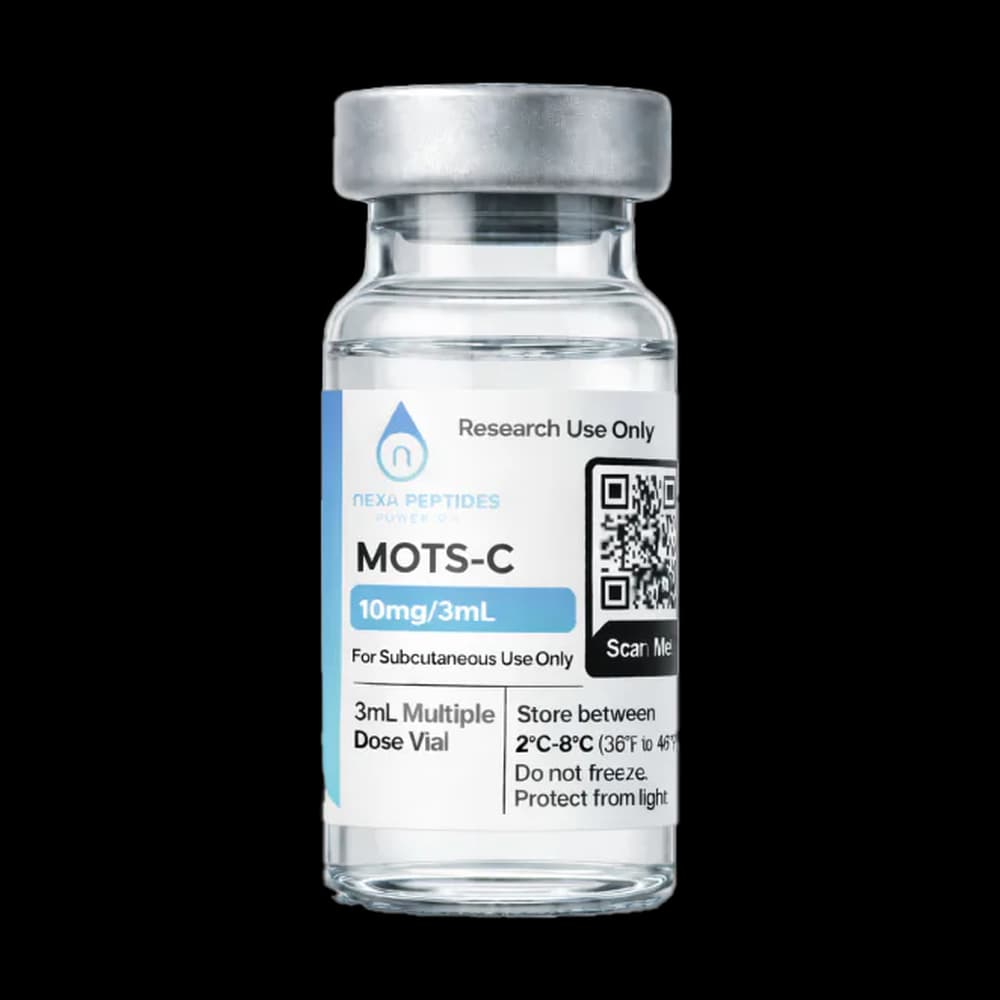
MOTS-c — - 10mg
SKU: NXP-MOTS-10
MOTS-c 10mg lyophilized peptide. Mitochondrial-derived peptide studied for metabolic signaling and cellular energy regulation. FOR RESEARCH USE ONLY.
Product Details
MOTS-c is a mitochondrial-derived peptide encoded by the 12S rRNA gene of mitochondrial DNA. As a naturally occurring signaling molecule, it has become a focal point in research on mitochondrial communication, metabolic regulation, and cellular energy homeostasis.
Researchers have investigated MOTS-c for its ability to activate AMPK (AMP-activated protein kinase) and influence the folate-methionine cycle. Studies in preclinical models have explored its effects on glucose metabolism, insulin sensitivity, exercise physiology, and age-related metabolic decline. Its unique origin as a mitochondrial-encoded peptide makes it a valuable tool for studying retrograde mitochondrial signaling.
Each vial contains 10mg of lyophilized MOTS-c, synthesized under GMP conditions with purity exceeding 98% by HPLC analysis. Quality control includes mass spectrometry confirmation and endotoxin testing. Certificate of analysis available upon request.
Storage: Store lyophilized at -20°C. Reconstituted at 2-8°C, use within 60 days.
For research and laboratory use only.
About MOTS-c
MOTS-c (Mitochondrial Open Reading Frame of the 12S rRNA-c) is a novel mitochondrial-derived peptide (MDP) that has garnered significant interest within the research community for its role as a key regulator of metabolic homeostasis. Unlike traditional peptides encoded by the nuclear genome, MOTS-c is unique in that it is encoded within the short open reading frame of the mitochondrial 12S rRNA gene. This 16-amino acid peptide, with the sequence Met-Arg-Trp-Gln-Glu-Met-Gly-Tyr-Ile-Phe-Tyr-Pro-Arg-Lys-Leu-Arg, functions as a mitokine—a signaling molecule originating from the mitochondria that exerts systemic effects on cellular metabolism and stress responses.
Its discovery has expanded the understanding of mitochondrial biology, revealing that mitochondria are not merely cellular powerhouses but also dynamic signaling organelles that actively communicate with the rest of the cell, including the nucleus, to coordinate adaptive responses. MOTS-c levels have been observed to decline with age in various tissues, positioning it as a compelling subject for investigations into age-related metabolic dysfunction and cellular senescence. Its endogenous nature and systemic effects make it a powerful tool for researchers studying the intricate connections between mitochondrial function, energy metabolism, insulin sensitivity, and longevity.
In preclinical research models, MOTS-c has been shown to mimic some of the metabolic benefits of exercise, enhancing glucose utilization and improving insulin sensitivity. It operates through complex signaling networks, influencing key metabolic pathways and gene expression programs. This has led to its extensive study in contexts ranging from diet-induced obesity and insulin resistance to age-associated physical decline and cellular stress.
Nexa Peptides provides high-purity, synthetic MOTS-c for in vitro and in vivo research applications. Our product enables investigators to explore the precise molecular mechanisms and physiological roles of this fascinating mitokine. All products are supplied for Research Use Only and are not intended for human or veterinary use. Rigorous quality control ensures that researchers receive a reliable and consistent product for their studies into metabolic health, aging, and exercise physiology.
Mechanism of Action
The mechanism of action for MOTS-c is multifaceted, reflecting its role as a systemic signaling molecule that integrates mitochondrial activity with cellular metabolic programming. A primary pathway influenced by MOTS-c is the AMP-activated protein kinase (AMPK) signaling cascade, a central regulator of cellular energy homeostasis. In skeletal muscle and other metabolically active tissues, MOTS-c has been shown to promote the phosphorylation and activation of AMPK. Activated AMPK, in turn, stimulates downstream processes that enhance cellular energy production and efficiency, such as increasing glucose uptake via translocation of GLUT4 transporters to the cell membrane and promoting fatty acid oxidation. This mechanism is functionally analogous to the cellular response to exercise, positioning MOTS-c as a subject of interest in studies of exercise mimetics.
Beyond AMPK activation, MOTS-c employs a distinct and highly significant mechanism involving the regulation of folate-methionine metabolism. Research has demonstrated that MOTS-c directly targets the folate cycle, inhibiting the enzyme 5-methyltetrahydrofolate-homocysteine methyltransferase (MTR). This action redirects folate metabolism towards the de novo purine synthesis pathway. This metabolic reprogramming is crucial for cellular adaptation to stress, as it supports nucleotide synthesis required for DNA repair and maintenance of redox balance through NADPH production. This pathway is a fundamental component of cellular resilience and is distinct from many other metabolic regulators.
Furthermore, MOTS-c exhibits nuclear translocation capabilities, allowing it to function as a transcriptional regulator. Under conditions of metabolic stress, MOTS-c moves from the cytoplasm to the nucleus, where it influences the expression of a suite of genes involved in stress response and metabolic adaptation. It has been shown to bind to the promoter regions of target genes, including those regulated by the Antioxidant Response Element (ARE), thereby enhancing the cell's capacity to counteract oxidative stress. This direct influence on the nuclear transcriptome represents a novel mode of mitochondria-to-nucleus communication, enabling a coordinated response to cellular challenges.
The peptide's molecular interactions are complex. For instance, its activation of the AMPK pathway is thought to occur, in part, by regulating the cellular levels of 5-aminoimidazole-4-carboxamide ribonucleotide (AICAR), an endogenous AMPK activator. By modulating these fundamental signaling nodes—AMPK, folate metabolism, and nuclear gene expression—MOTS-c orchestrates a comprehensive adaptive response to metabolic demands. This intricate mechanism allows researchers to investigate how mitochondrial signals can systemically regulate insulin sensitivity, physical endurance, and cellular longevity in various preclinical models. All investigations into these pathways should be conducted in controlled laboratory settings for research purposes only.
Research Applications
MOTS-c is a peptide of significant interest across several fields of biomedical research, primarily due to its profound effects on metabolism and cellular aging observed in preclinical models. Its applications in laboratory settings are broad, providing a valuable tool for investigating fundamental biological processes.
One of the most prominent areas of MOTS-c research is metabolic regulation. In numerous in vivo studies using rodent models of diet-induced obesity and insulin resistance, administration of MOTS-c has been investigated for its ability to improve glucose homeostasis and enhance insulin sensitivity. Researchers have observed that the peptide can prevent or reverse metabolic dysregulation by promoting glucose utilization in peripheral tissues, particularly skeletal muscle. These studies are critical for elucidating the molecular pathways that link mitochondrial function to systemic metabolic health and for exploring potential targets in models of type 2 diabetes and metabolic syndrome.
In the field of aging and exercise physiology, MOTS-c has been studied for its potential to counteract age-related functional decline. Preclinical studies in aged mice have demonstrated that MOTS-c can improve physical performance, enhancing endurance and muscle function. These investigations explore how MOTS-c may mimic the beneficial effects of exercise at a molecular level, activating pathways that promote metabolic efficiency and cellular resilience. This makes it a key compound for researchers studying sarcopenia, frailty, and the biology of healthy aging.
MOTS-c is also utilized in studies of cellular senescence and longevity. By modulating stress response pathways and enhancing mitochondrial function, the peptide has been examined for its effects on cellular healthspan in vitro. Research in cell culture models investigates its capacity to protect against oxidative stress, a key driver of cellular damage and aging. These studies aim to understand how signals from the mitochondria can influence the rate of aging and the onset of age-related cellular pathologies.
Further research applications extend to other age-related conditions. For example, its role in maintaining skeletal homeostasis has been explored in models of osteoporosis, where it has been studied for its potential to promote osteoblast differentiation and function. Additionally, preliminary investigations in cellular and animal models of neurodegeneration are exploring whether the metabolic and anti-stress effects of MOTS-c could have protective applications in the central nervous system. All such applications are strictly for non-clinical, laboratory-based research to further scientific understanding. For Research Use Only.
Formulation & Handling
For optimal results and to ensure experimental integrity, proper handling and storage of lyophilized MOTS-c are critical. The lyophilized peptide is stable at room temperature for short periods but should be stored at -20°C or colder for long-term preservation. When stored correctly in its powdered form, the peptide can maintain its integrity for an extended duration. It is recommended to keep the vial sealed and protected from light until it is ready for reconstitution.
Reconstitution should be performed under sterile conditions using an appropriate solvent, typically bacteriostatic water or sterile water for research. The choice of diluent may depend on the specific experimental protocol. To reconstitute, gently inject the desired volume of solvent into the vial, allowing it to run down the side of the glass. The solution should be mixed by gently swirling or rotating the vial. Avoid vigorous shaking, as this can cause shearing and denaturation of the peptide structure. Ensure the peptide is fully dissolved before use.
Once reconstituted, the MOTS-c solution should be stored at 2-8°C for short-term use, typically up to one to two weeks. For longer-term studies, it is highly recommended to aliquot the solution into smaller, single-use volumes and freeze them at -20°C or -80°C. This practice prevents degradation from repeated freeze-thaw cycles, which can compromise the peptide's stability and bioactivity. Always use properly calibrated equipment for measurements to ensure accurate concentrations in experimental assays. This product is intended solely for laboratory research purposes.
Quality Standards
Nexa Peptides is committed to providing researchers with the highest quality MOTS-c for their laboratory investigations. Our synthesis and purification processes adhere to stringent quality control standards to ensure the reliability and reproducibility of your experimental results. Each batch of MOTS-c is manufactured in a cGMP-compliant facility using solid-phase peptide synthesis (SPPS), a method renowned for producing peptides of exceptional purity and structural accuracy.
To guarantee quality, every lot undergoes a comprehensive panel of analytical tests. Purity is verified using High-Performance Liquid Chromatography (HPLC), with all batches of MOTS-c required to meet a purity standard of >99%. The identity and molecular weight of the peptide are confirmed via Mass Spectrometry (MS), ensuring that the correct amino acid sequence has been synthesized. Furthermore, we conduct endotoxin testing to ensure that the final product is free from contaminants that could interfere with in vitro or in vivo studies, particularly those involving cell cultures.
Transparency and documentation are paramount to our quality assurance program. A third-party Certificate of Analysis (COA) is available for every batch, providing detailed results of the HPLC and MS analyses. This documentation allows researchers to have full confidence in the product they are using. With rigorous lot traceability and unwavering commitment to quality, Nexa Peptides provides a research-grade MOTS-c that meets the exacting demands of the scientific community. All our products are supplied strictly for Research Use Only.
Frequently Asked Questions
What is MOTS-c?
How is MOTS-c synthesized?
What is the molecular weight of MOTS-c?
What research areas use MOTS-c?
How should MOTS-c be stored?
How should MOTS-c be reconstituted for research?
What purity grade is Nexa Peptides' MOTS-c?
Is MOTS-c available with a Certificate of Analysis?
Explore Related Research
Customer Reviews
2 reviews
Kevin J.Apr 13, 2026
My energy is back in a way I had honestly given up on. Mornings do not feel like a battle anymore.
Sarah M.Mar 20, 2026
Subtle at first then more obvious by week three. The kind of steady improvement I trust.