
Anti-Aging
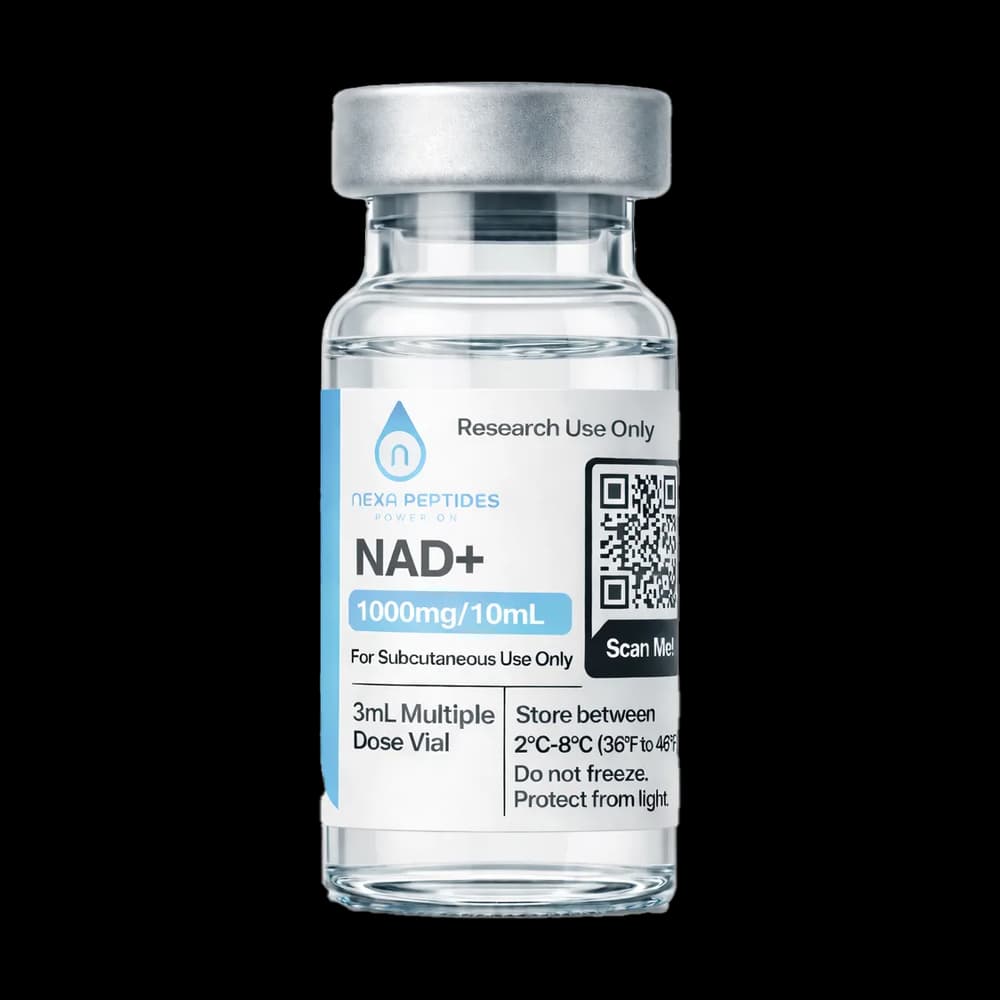
NAD+ — 1000mg
SKU: NXP-NAD-1000
High-dose NAD+ for enhanced cellular energy and longevity support. NAD+ 1000mg — a vital coenzyme that supports cellular energy, DNA repair, and healthy aging by enhancing mitochondrial function and metabolic efficiency. RESEARCH USE ONLY.
Product Details
NAD+ (Nicotinamide Adenine Dinucleotide) is a critical coenzyme found in every cell. This high-dose 1000mg formulation supports cellular energy production, DNA repair, and healthy aging pathways. Research suggests NAD+ supplementation may help maintain mitochondrial function and support overall metabolic health.
RESEARCH AND LABORATORY USE ONLY
About NAD+
Nicotinamide Adenine Dinucleotide (NAD+) is a fundamental dinucleotide coenzyme present in all living cells, serving as a cornerstone of cellular metabolism and signaling. Structurally, it is composed of two nucleotides joined through their phosphate groups: one nucleotide contains an adenine base and the other a nicotinamide base. NAD+ exists in two forms: its oxidized state (NAD+) and its reduced state (NADH). This redox couple is central to cellular bioenergetics, acting as a critical electron carrier in metabolic pathways that generate adenosine triphosphate (ATP), the primary energy currency of the cell.
Beyond its canonical role in redox reactions, NAD+ has emerged as a critical signaling molecule and a substrate for several key enzyme families. These include sirtuins (SIRTs), a class of NAD+-dependent deacetylases that regulate gene expression, metabolic pathways, and stress responses, and poly(ADP-ribose) polymerases (PARPs), which are essential for DNA repair and genomic stability. The consumption of NAD+ by these enzymes links cellular energy status directly to the regulation of longevity, DNA integrity, and cellular homeostasis, making it a molecule of immense interest in contemporary biological research.
The concentration of NAD+ within cells is known to decline significantly with age and in various pathophysiological states. This decline is hypothesized to be a contributing factor to the functional impairments observed in aging and age-related diseases. Consequently, the study of NAD+ metabolism and the investigation of strategies to maintain or replete cellular NAD+ pools have become a major focus in research areas such as aging, metabolic disorders, and neurodegeneration.
For researchers, high-purity NAD+ is an indispensable tool for in vitro and in vivo studies aimed at elucidating these complex biological processes. It enables the investigation of enzyme kinetics, the modulation of cellular signaling pathways, and the assessment of metabolic function in various preclinical models. Nexa Peptides provides highly purified NAD+ for laboratory applications, ensuring that researchers have access to a reliable and consistent compound for their experimental needs. This product is intended strictly for Research Use Only (RUO) and is not for human or veterinary use.
Mechanism of Action
The mechanism of action of Nicotinamide Adenine Dinucleotide (NAD+) is multifaceted, reflecting its dual role as both a metabolic coenzyme and a signaling substrate. Its most fundamental function lies in cellular respiration, where it acts as a hydride ion (H-) acceptor in catabolic pathways. In glycolysis and the citric acid cycle, enzymes such as glyceraldehyde-3-phosphate dehydrogenase and isocitrate dehydrogenase oxidize their substrates by transferring two electrons and a proton to NAD+, reducing it to NADH. This NADH then serves as an electron donor to Complex I (NADH:ubiquinone oxidoreductase) of the mitochondrial electron transport chain. The subsequent transfer of electrons down the chain drives proton pumping across the inner mitochondrial membrane, establishing the electrochemical gradient necessary for ATP synthase to produce ATP. This redox cycling between NAD+ and NADH is the linchpin of cellular energy production.
In its non-redox capacity, NAD+ serves as a cosubstrate for several enzyme families that cleave the molecule to regulate critical cellular processes. The sirtuins (SIRT1-7) are a class of NAD+-dependent protein deacetylases and ADP-ribosyltransferases. Sirtuins catalyze the removal of acetyl groups from lysine residues on target proteins, a reaction that consumes one molecule of NAD+ and yields nicotinamide (NAM), O-acetyl-ADP-ribose, and the deacetylated protein. This activity directly links the cell's metabolic state (as reflected by the NAD+/NADH ratio) to the regulation of gene expression and protein function. Key sirtuin targets include transcription factors like PGC-1α, FOXO, and p53, thereby influencing mitochondrial biogenesis, stress resistance, and apoptosis.
Poly(ADP-ribose) polymerases (PARPs), particularly PARP1, are another major consumer of cellular NAD+. Upon detection of DNA strand breaks, PARP1 binds to the damaged site and utilizes NAD+ as a substrate to synthesize long, branched chains of poly(ADP-ribose) (PAR) onto itself and other nuclear proteins. This PARylation process creates a negatively charged scaffold that recruits DNA repair machinery to the site of damage. While essential for genomic stability, hyperactivation of PARP in response to extensive DNA damage can rapidly deplete cellular NAD+ and ATP pools, leading to a bioenergetic crisis and programmed cell death.
Finally, NAD+ is hydrolyzed by NAD+ glycohydrolases, such as CD38 and CD157, which are primarily located on the cell surface. CD38 is the principal NADase in mammalian cells and catalyzes the conversion of NAD+ into nicotinamide and ADP-ribose (ADPR), as well as the signaling molecule cyclic ADP-ribose (cADPR). Both ADPR and cADPR are involved in regulating intracellular calcium signaling. The activity of these enzymes, particularly the age-associated increase in CD38 expression, is considered a major contributor to the decline in NAD+ levels observed during aging. The intricate balance between NAD+ synthesis pathways (de novo, Preiss-Handler, and salvage) and its consumption by SIRTs, PARPs, and CD38 positions NAD+ as a critical regulatory node governing cellular fate and function, making it a prime subject for laboratory investigation.
Research Applications
In laboratory settings, NAD+ is a vital compound for investigating a wide spectrum of biological phenomena, particularly those related to cellular metabolism, aging, and disease modeling. Its fundamental role makes it a tool of choice in numerous preclinical research applications. One of the most prominent areas of study is cellular aging and senescence. Researchers utilize in vitro models with senescent cells or in vivo studies with aged animal models to explore how direct supplementation or modulation of NAD+ levels affects hallmarks of aging. These investigations often measure endpoints such as sirtuin activity, mitochondrial respiration rates, DNA damage accumulation (e.g., γH2AX foci), and the expression of senescence-associated secretory phenotype (SASP) factors to understand the mechanistic link between NAD+ availability and the aging process.
Metabolic research is another key application. In cell culture systems (e.g., hepatocytes, myotubes, adipocytes) and rodent models of metabolic syndrome or diet-induced obesity, NAD+ is studied for its effects on energy homeostasis. Investigators examine its capacity to modulate key signaling pathways such as those governed by AMPK and mTOR, improve glucose tolerance, and enhance mitochondrial fatty acid oxidation. Such studies are critical for dissecting the molecular machinery that connects cellular energy status to systemic metabolic health and for exploring potential intervention points in preclinical models of metabolic disease.
In the field of neurobiology, the high energy demand of the central nervous system makes NAD+ metabolism a critical area of investigation. Researchers use NAD+ in primary neuronal cultures, organotypic brain slices, and animal models of neurodegenerative conditions to study its role in neuronal survival and function. Studies often focus on whether maintaining NAD+ pools can protect neurons from excitotoxicity, oxidative stress, or proteotoxicity by supporting mitochondrial function, enhancing DNA repair via PARP activity, and activating neuroprotective sirtuin pathways. These preclinical models help elucidate the potential contribution of NAD+ depletion to neurodegenerative pathogenesis.
Furthermore, NAD+ is extensively used in studies of DNA repair and genome integrity. Given its role as the sole substrate for PARP enzymes, NAD+ is essential for in vitro assays designed to measure PARP activity or to study the dynamics of the DNA damage response. Researchers may use NAD+ in cell-free systems to analyze PARP kinetics or in cell-based assays where cells are subjected to genotoxic agents. These experiments are foundational to understanding cellular responses to DNA damage, with implications for cancer research and the study of genetic instability in aging.
Cardiovascular research also utilizes NAD+ to investigate cellular resilience to stress. In isolated cardiomyocyte models or in vivo models of cardiac ischemia-reperfusion injury, scientists study whether bolstering NAD+ levels can mitigate tissue damage. The focus is often on the role of mitochondrial sirtuins like SIRT3 in preserving mitochondrial function and reducing reactive oxygen species (ROS) production during periods of metabolic stress. All research applications involving NAD+ are strictly for investigational, non-clinical purposes. For Research Use Only.
Formulation & Handling
For optimal stability and integrity, lyophilized NAD+ powder should be stored in a freezer at temperatures between -20°C and -80°C. The container must be kept tightly sealed and protected from exposure to light and moisture to prevent degradation. Proper long-term storage under these conditions is critical to preserving the compound's purity and biological activity for the duration of its shelf life.
Reconstitution of lyophilized NAD+ for experimental use should be performed under sterile conditions. A suitable solvent, such as bacteriostatic water or sterile deionized water, should be used as specified by the research protocol. To reconstitute, slowly inject the calculated volume of solvent down the side of the vial to minimize foaming. The vial should then be gently swirled or inverted until the powder is fully dissolved. Vigorous shaking should be avoided as it can potentially denature some compounds, although NAD+ is a robust small molecule.
Once in solution, NAD+ should be handled with care to maintain its stability. For short-term use (within several days), the reconstituted solution can typically be stored at 2-8°C. For longer-term storage, it is highly recommended to aliquot the solution into single-use volumes in sterile, low-protein-binding tubes and freeze them at -20°C or -80°C. This practice prevents degradation that can occur with repeated freeze-thaw cycles. Researchers should always refer to the specific stability data provided on the product's Certificate of Analysis for precise handling guidelines.
Quality Standards
Nexa Peptides is committed to providing researchers with the highest quality NAD+ for their laboratory investigations. Our stringent quality control process ensures that every batch of our NAD+ meets the exacting standards required for reproducible scientific outcomes. The purity of each lot is quantitatively determined using High-Performance Liquid Chromatography (HPLC), a highly sensitive analytical technique. We guarantee a purity level of greater than 99%, ensuring that researchers are working with a compound free from significant impurities that could confound experimental results.
To further validate the product, the identity and molecular weight of our NAD+ are rigorously confirmed using Mass Spectrometry (MS). This analysis provides an unambiguous verification of the compound's chemical structure. Additionally, each batch is tested for the presence of endotoxins, which is particularly critical for researchers conducting in vitro experiments with cell cultures, as endotoxin contamination can elicit unintended cellular responses. All manufacturing is conducted in accordance with Current Good Manufacturing Practices (cGMP) to ensure consistency and quality.
Transparency and documentation are paramount in research. Therefore, every purchase of NAD+ is accompanied by a comprehensive, lot-specific Certificate of Analysis (COA). This document provides detailed results from our third-party analytical testing, including the precise HPLC purity, MS confirmation, and appearance. This commitment to quality and transparency provides researchers with the confidence and data they need to trust the integrity of their experiments. This product is sold for Research Use Only.
Frequently Asked Questions
What is NAD+?
How is NAD+ synthesized?
What is the molecular weight of NAD+?
What research areas use NAD+?
How should NAD+ be stored?
How should NAD+ be reconstituted for research?
What purity grade is Nexa Peptides' NAD+?
Is NAD+ available with a Certificate of Analysis?
Explore Related Research
Customer Reviews
2 reviews
Derek C.Verified PurchaseMay 14, 2026
I have more in the tank for both workouts and the back half of the work day. Big quality of life upgrade.
David W.Mar 22, 2026
Consistent quality across multiple orders is why I keep coming back here.