
Anti-Aging
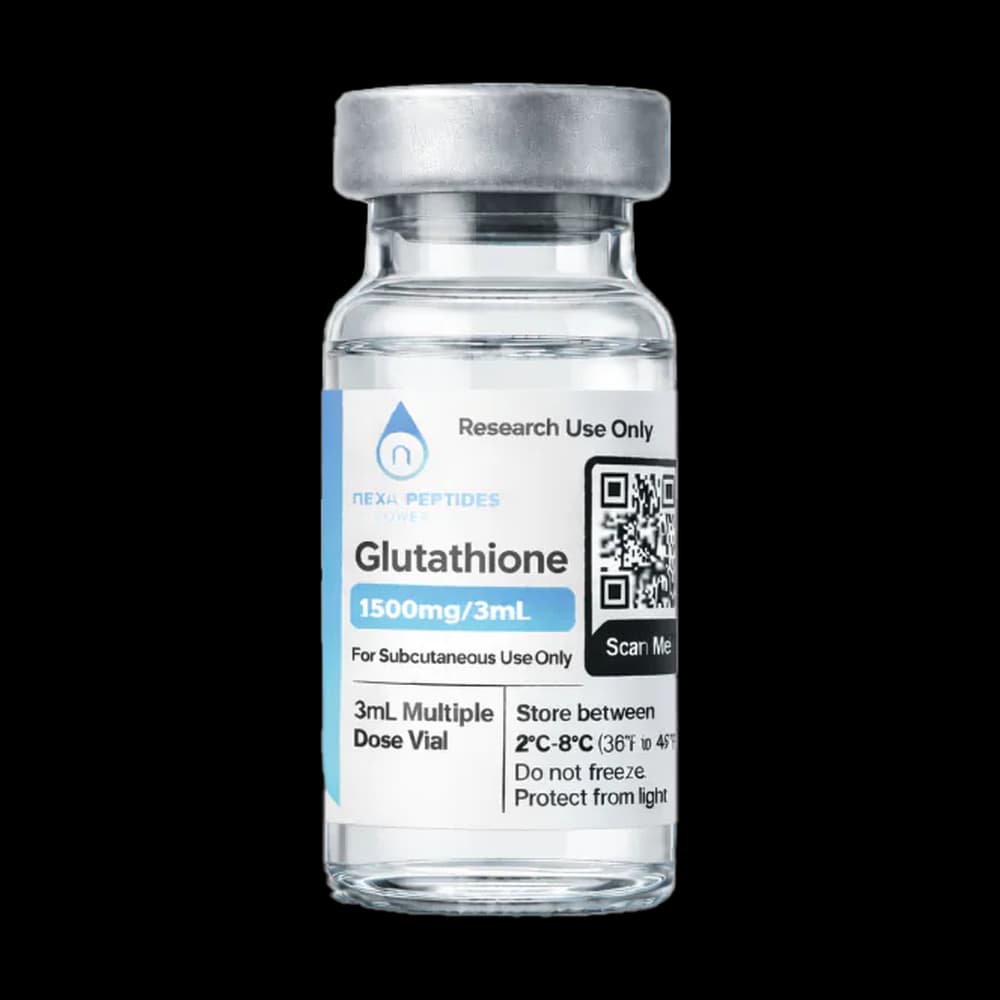
Glutathione — - 1500mg
SKU: NXP-GLUT-1500
Glutathione 1500mg lyophilized peptide. Naturally occurring tripeptide studied for antioxidant defense, cellular detoxification, and oxidative stress regulation. FOR RESEARCH USE ONLY..
Product Details
Glutathione (L-glutathione, GSH) is a tripeptide composed of glutamic acid, cysteine, and glycine, serving as the primary intracellular antioxidant in mammalian cells. This 1500mg research-grade preparation provides a substantial quantity for laboratory investigations into oxidative stress pathways, Phase II detoxification enzymes, and cellular redox homeostasis.
Research applications include studies of glutathione-S-transferase activity, glutathione peroxidase kinetics, thiol-disulfide exchange reactions, and the glutathione/GSSG redox couple as a biomarker of oxidative damage. Additional investigations have examined its role in xenobiotic metabolism, heavy metal chelation, and immune cell function modulation.
Manufactured under strict quality-control protocols with analytical verification of reduced glutathione content and purity. Each lot is tested for heavy metals, microbial contamination, and moisture content to ensure research-grade quality and batch-to-batch consistency.
Store at -20°C in a desiccated environment. Reconstituted solutions should be used promptly or stored at 2-8°C and used within 60 days, as reduced glutathione is susceptible to oxidation.
For research and laboratory use only.
About Glutathione
Glutathione (γ-L-Glutamyl-L-cysteinylglycine) is a tripeptide of profound significance in cellular biochemistry and redox biology. Composed of three amino acids—glutamate, cysteine, and glycine—it is the most abundant non-protein thiol in mammalian cells, where it exists in two primary states: the reduced form (GSH) and the oxidized form, glutathione disulfide (GSSG). The ratio of GSH to GSSG is a critical indicator of cellular oxidative stress and serves as a key regulator of the intracellular redox environment. With a molecular weight of 307.32 g/mol, GSH is central to a multitude of cellular processes, including antioxidant defense, detoxification of xenobiotics, and the modulation of signal transduction pathways.
The unique chemical structure of Glutathione, particularly the nucleophilic thiol group (-SH) of its cysteine residue, endows it with potent reducing capabilities. This allows it to directly neutralize reactive oxygen species (ROS) and reactive nitrogen species (RNS), such as hydroxyl radicals, superoxide anions, and peroxynitrite. Beyond this direct scavenging activity, GSH serves as an essential cofactor for several families of antioxidant and detoxification enzymes, including glutathione peroxidases (GPx) and glutathione S-transferases (GSTs). This dual function makes it an indispensable molecule for maintaining cellular integrity and function in the face of endogenous and exogenous stressors.
For researchers, Glutathione is not merely a subject of study but a critical tool for investigating cellular health and disease models. Its availability as a high-purity research compound allows for its use in a wide array of experimental contexts. In cell culture studies, exogenous Glutathione can be used to probe the cellular response to oxidative insults, investigate the mechanisms of drug resistance, or modulate redox-sensitive signaling pathways. In preclinical research models, the quantification of GSH levels and the GSH/GSSG ratio provides valuable data on the oxidative status of tissues. Nexa Peptides provides research-grade Glutathione, synthesized and purified to meet the stringent demands of scientific investigation, ensuring reproducibility and accuracy in laboratory settings.
This product is intended exclusively for laboratory research applications. It is not formulated or approved for human or veterinary use. All handling and application of this compound should be performed by qualified professionals in a controlled research environment.
Mechanism of Action
The biochemical mechanism of Glutathione is multifaceted, positioning it as a master regulator of cellular redox homeostasis. Its primary function is rooted in the redox-active thiol group of its cysteine residue, which acts as a potent electron donor. This allows Glutathione (GSH) to directly neutralize a wide spectrum of reactive oxygen and nitrogen species, thereby mitigating molecular damage to DNA, proteins, and lipids. In these non-enzymatic reactions, GSH is oxidized to form glutathione disulfide (GSSG), which consists of two glutathione molecules linked by a disulfide bond.
The maintenance of a high intracellular GSH/GSSG ratio, typically exceeding 100:1 in healthy cells, is critical and is actively managed by the enzyme glutathione reductase (GR). This NADPH-dependent flavoenzyme catalyzes the reduction of GSSG back to two molecules of GSH, thus regenerating the cellular antioxidant pool. The NADPH required for this reaction is primarily supplied by the pentose phosphate pathway, directly linking cellular energy metabolism to its antioxidant capacity.
Beyond direct radical scavenging, Glutathione functions as an essential substrate for two major enzyme families. First, the glutathione peroxidases (GPx) utilize GSH as a reducing equivalent to detoxify hydrogen peroxide (H₂O₂) and organic hydroperoxides. In this process, two molecules of GSH are consumed to reduce one molecule of peroxide, yielding GSSG and water (or an alcohol). This enzymatic system represents a primary defense against peroxide-induced oxidative damage. Second, the glutathione S-transferases (GSTs) catalyze the conjugation of the thiol group of GSH to a vast array of electrophilic xenobiotics and endogenous metabolites. This reaction, known as mercapturic acid synthesis, increases the water solubility of the target compounds, facilitating their transport and excretion from the cell, a cornerstone of Phase II detoxification.
The cellular redox state, as defined by the GSH/GSSG ratio, is not merely a passive indicator of stress but an active modulator of cellular signaling. A shift towards a more oxidizing environment (lower GSH/GSSG ratio) can trigger specific post-translational modifications on proteins, most notably S-glutathionylation. This reversible process involves the formation of a mixed disulfide bond between GSH and a protein cysteine residue, which can alter protein structure, function, and localization. S-glutathionylation has been shown to regulate the activity of numerous transcription factors and signaling proteins, including those in the NF-κB, AP-1, and MAP kinase pathways (e.g., JNK, p38). This mechanism allows the cell to sense and adapt to changes in its redox environment, influencing processes such as proliferation, apoptosis, and inflammation. Glutathione is therefore a central node in the complex network that integrates metabolic state with cellular stress responses.
Research Applications
In laboratory research, Glutathione is a fundamental compound used across a diverse range of disciplines to investigate the mechanisms of cellular protection, toxicology, and redox-regulated signaling. Its primary application is in studies of oxidative stress. Researchers frequently employ *in vitro* models, such as primary cell cultures or established cell lines, where oxidative insults are induced using agents like hydrogen peroxide, menadione, or paraquat. In these experimental setups, the addition of exogenous GSH to the culture medium is studied for its potential to preserve cell viability, maintain mitochondrial membrane potential, and prevent apoptosis, providing direct insights into its cytoprotective roles.
Toxicology research extensively utilizes Glutathione to explore Phase II detoxification pathways. Studies may involve incubating cell lysates or microsomal fractions with various xenobiotics in the presence of GSH and glutathione S-transferases (GSTs) to characterize metabolic pathways and identify conjugated metabolites. Furthermore, researchers often deplete endogenous GSH levels in cell models, using inhibitors of its synthesis like buthionine sulfoximine (BSO), to investigate the role of the glutathione system in mediating the cytotoxicity of specific drugs or environmental toxins. These models are crucial for understanding mechanisms of chemoresistance in cancer cell lines or the hepatotoxicity of certain compounds.
In the field of neurobiology, Glutathione is investigated in the context of neurodegenerative disease models. Preclinical studies using animal models or neuronal cell cultures for conditions such as Parkinson's or Alzheimer's disease often measure tissue-specific GSH levels and the GSH/GSSG ratio as key biomarkers of oxidative damage. Research protocols may examine whether interventions that modulate the glutathione synthesis pathway can affect neuronal survival, protein aggregation (e.g., alpha-synuclein or amyloid-beta), or mitochondrial function in these non-human systems. These investigations are critical for elucidating the role of redox imbalance in the pathogenesis of neurological disorders.
Aging research also represents a significant area of application. Cellular senescence, the process of irreversible cell cycle arrest, is closely linked to cumulative oxidative damage. Researchers utilize models of replicative senescence in fibroblasts or induced senescence in other cell types to study the dynamic changes in the glutathione system over time. In model organisms like *Saccharomyces cerevisiae* or *Caenorhabditis elegans*, genetic manipulation of enzymes involved in glutathione synthesis or regeneration is employed to investigate the impact of cellular redox state on lifespan and healthspan. These studies help to dissect the molecular connections between antioxidant defenses and the aging process. All such research is conducted for investigational purposes only and is not intended for human application.
Formulation & Handling
For optimal stability and integrity in research applications, lyophilized Glutathione should be stored in a freezer at temperatures between -20°C and -80°C. When stored under these conditions, the lyophilized powder remains stable for an extended period. It is recommended to keep the product sealed in its original vial, protected from moisture and light, until it is ready for use.
Reconstitution should be performed using sterile, high-purity solvents. Sterile bacteriostatic water is a common choice for creating a stock solution. To reconstitute, slowly inject the desired volume of solvent into the vial, allowing it to run down the side of the glass. Agitate the vial gently by swirling or inverting it until the powder is fully dissolved. Avoid vigorous shaking or vortexing, as this can introduce oxidative stress or potentially degrade the peptide. The final concentration of the stock solution should be determined based on the specific requirements of the experimental protocol.
Once reconstituted, the Glutathione solution is susceptible to oxidation, especially at neutral or alkaline pH. For short-term storage (1-3 days), the solution should be kept refrigerated at 2-8°C. For long-term studies, it is highly recommended to aliquot the stock solution into single-use volumes in sterile microcentrifuge tubes and store them frozen at -20°C or -80°C. This practice minimizes waste and prevents degradation associated with repeated freeze-thaw cycles. Always use sterile techniques during handling to prevent microbial contamination.
Quality Standards
Nexa Peptides is committed to providing researchers with Glutathione of the highest possible quality and purity to ensure the validity and reproducibility of experimental results. Each batch of our Glutathione is subjected to a rigorous quality control process. Purity is determined using High-Performance Liquid Chromatography (HPLC), which separates the target peptide from any potential impurities. We guarantee a purity level of greater than 99% for all our research peptides, and the specific purity of each lot is detailed on its accompanying Certificate of Analysis.
To confirm the identity and structural integrity of the compound, we employ Mass Spectrometry (MS) analysis. This technique verifies that the molecular weight of the synthesized peptide matches the theoretical weight of γ-L-Glutamyl-L-cysteinylglycine (307.32 Da), ensuring you receive the correct molecule for your research. Furthermore, our products are tested for residual contaminants, including endotoxins, to ensure they are suitable for sensitive applications such as cell culture studies.
Our Glutathione is manufactured in facilities that adhere to cGMP (Current Good Manufacturing Practices) principles, ensuring consistency, quality, and traceability from synthesis to final packaging. Every purchase is accompanied by a lot-specific Certificate of Analysis (COA), which provides detailed analytical data from our third-party testing partners. This documentation offers researchers complete transparency and confidence in the quality of the product they are using in their laboratory investigations.
Frequently Asked Questions
What is Glutathione?
How is Glutathione synthesized?
What is the molecular weight of Glutathione?
What research areas use Glutathione?
How should Glutathione be stored?
How should Glutathione be reconstituted for research?
What purity grade is Nexa Peptides' Glutathione?
Is Glutathione available with a Certificate of Analysis?
Explore Related Research
Customer Reviews
4 reviews
Rachel E.May 27, 2026
Third order in and I have stopped shopping around. They have earned the repeat business.
Renee D.Verified PurchaseMay 16, 2026
Sleep is deeper and I wake up actually rested. The effect on my daytime energy has been huge.
Ken H.May 7, 2026
Support answered my question about storage within a few hours. Nice to deal with people who actually respond.
Phil H.Apr 21, 2026
Less of that run down feeling by evening. I am not crawling to bed completely wiped anymore.