
Anti-Aging
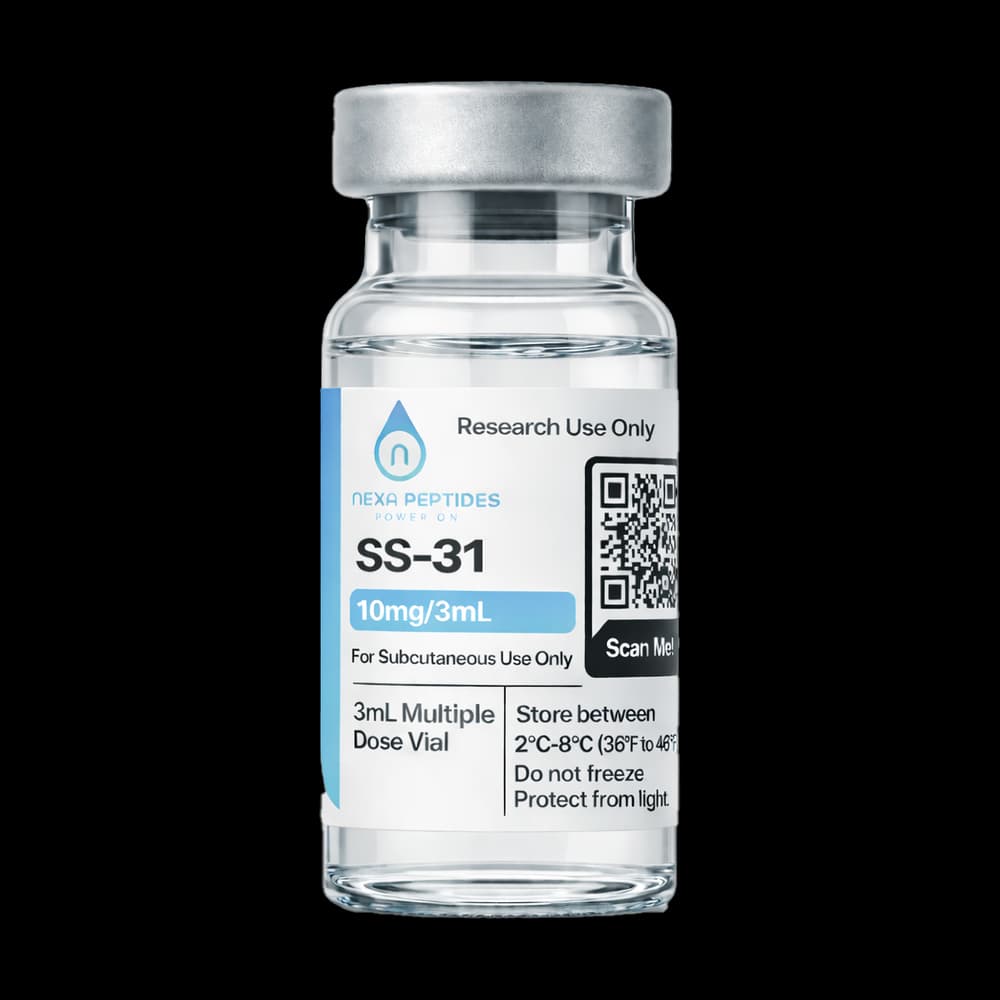
SS-31 (Elamipretide) — SS-31 10mg
SKU: NXP-SS31-01
Product Details
SS-31 (elamipretide) is a cell-permeable, mitochondria-targeted tetrapeptide (D-Arg-Dmt-Lys-Phe-NH2) that selectively concentrates in the inner mitochondrial membrane. This research-grade lyophilized preparation provides material for studies investigating mitochondrial bioenergetics, cardiolipin interactions, and electron transport chain optimization.
Preclinical research has examined SS-31 in models of mitochondrial dysfunction, ischemia-reperfusion injury, age-related bioenergetic decline, and neurodegenerative pathology. Studies have focused on its interaction with cardiolipin to stabilize cytochrome c electron carrier function, reduce reactive oxygen species generation at Complex I and III, and improve ATP synthesis efficiency.
Manufactured under rigorous quality-control standards with HPLC purity exceeding 98% and mass spectrometry confirmation of the modified amino acid sequence. Endotoxin-tested and sterility-verified. Full certificate of analysis provided with each lot.
Store lyophilized at -20°C. Reconstituted at 2-8°C, use within 30 days. Protect from light. Avoid repeated freeze-thaw cycles to maintain peptide integrity.
For research and laboratory use only. Not for human consumption.
About SS-31 (Elamipretide)
SS-31, also known by the investigational name Elamipretide, is a synthetic tetrapeptide that has garnered significant attention within the scientific community for its unique mitochondrially-targeted antioxidant properties. As a member of the Szeto-Schiller (SS) family of peptides, SS-31 is characterized by an alternating aromatic-cationic amino acid sequence: D-Arg-Dmt-Lys-Phe-NH2 (D-Arginine, 2',6'-Dimethyltyrosine, L-Lysine, L-Phenylalanine-amide). The inclusion of a D-amino acid (D-Arg) and the modified tyrosine residue (Dmt) confers substantial resistance to proteolytic degradation, enhancing its stability in biological research models.
Structurally, SS-31 is a small, water-soluble molecule with a net positive charge at physiological pH. This cationic nature, combined with its lipophilic domains, facilitates its rapid and receptor-independent translocation across cellular membranes. Critically, it exhibits a strong electrochemical potential-driven accumulation within the mitochondria, specifically targeting the inner mitochondrial membrane (IMM). This precise subcellular localization allows it to exert its effects directly at the primary site of cellular respiration and reactive oxygen species (ROS) production, distinguishing it from general, non-targeted antioxidants.
The peptide's primary interaction is with cardiolipin, a phospholipid almost exclusively found in the IMM that is essential for the optimal function of the electron transport chain (ETC) and ATP synthase. By stabilizing cardiolipin and preventing its oxidative damage, SS-31 is investigated as a tool to preserve mitochondrial integrity and function under conditions of cellular stress. Its mechanism is fundamental to cellular bioenergetics, making it a subject of intense investigation in research areas related to age-associated cellular decline, ischemia-reperfusion injury, and neurodegenerative processes where mitochondrial dysfunction is a key pathological feature.
For researchers, SS-31 represents a sophisticated tool to probe the role of mitochondrial health in cellular physiology and pathophysiology. Its targeted action allows for the specific study of mitochondrial-derived oxidative stress and its downstream consequences, without the confounding effects of broad-spectrum antioxidants. All SS-31 supplied by Nexa Peptides is synthesized to the highest purity standards for reliable and reproducible results in laboratory settings. This product is intended strictly for Research Use Only (RUO) and is not approved for human or veterinary use.
Mechanism of Action
The mechanism of action of SS-31 (Elamipretide) is a compelling example of targeted subcellular pharmacology, focusing directly on the bioenergetic core of the cell: the mitochondrion. Unlike conventional ligands that bind to cell-surface receptors to initiate signaling cascades, SS-31 operates intracellularly, primarily through its high-affinity interaction with cardiolipin (CL) on the inner mitochondrial membrane (IMM).
The peptide's structure, featuring alternating cationic (D-Arg, Lys) and aromatic/hydrophobic (Dmt, Phe) residues, is key to its function. This motif facilitates an electrostatic interaction between the peptide's positive charges and the negatively charged phosphate groups of CL, as well as a hydrophobic interaction between the aromatic rings and CL's acyl chains. This binding is not merely sequestration; it is a structural stabilization. SS-31 helps maintain the unique conical shape of CL, which is critical for organizing the respiratory supercomplexes of the electron transport chain (ETC) and maintaining the curvature of the mitochondrial cristae.
One of the principal mechanistic pillars of SS-31 is its role as a targeted antioxidant. The IMM is the primary site of endogenous reactive oxygen species (ROS) production. Under pathological conditions, excessive ROS can lead to the peroxidation of cardiolipin. Peroxidized CL loses its affinity for cytochrome c, causing the protein to detach from the IMM and function as a pro-apoptotic peroxidase in the cytosol, initiating the intrinsic apoptotic cascade. SS-31, by binding to CL, shields it from peroxidation by cytochrome c. Furthermore, the dimethyltyrosine (Dmt) residue in SS-31 possesses potent electron-scavenging capabilities, allowing it to directly neutralize ROS such as hydrogen peroxide and hydroxyl radicals at their source, thereby mitigating oxidative damage to mitochondrial proteins, lipids, and DNA.
By preserving the integrity of cardiolipin and the ETC supercomplexes, SS-31 directly supports mitochondrial bioenergetics. In preclinical models of cellular stress, it has been shown to restore mitochondrial membrane potential (ΔΨm), improve electron transport flux, and enhance ATP synthesis efficiency. This restoration of energy production is critical for cellular survival and function, particularly in high-energy-demand tissues like the heart, brain, and kidneys.
The downstream effects of SS-31's action are profound. By reducing mitochondrial ROS and preventing the release of cytochrome c, it effectively inhibits the activation of caspase-9 and the subsequent executioner caspases, thereby attenuating apoptosis. While not a direct activator of major signaling pathways like PI3K/Akt or mTOR, its ability to restore cellular ATP levels can indirectly influence energy-sensing pathways such as the AMP-activated protein kinase (AMPK) pathway. Improved mitochondrial health can also favorably modulate mitochondrial dynamics, shifting the balance from fission (fragmentation) towards fusion (elongation), resulting in a more robust and interconnected mitochondrial network. This comprehensive mechanism makes SS-31 an invaluable research compound for studying the fundamental role of mitochondrial integrity in cellular homeostasis.
Research Applications
SS-31 (Elamipretide) is a widely utilized peptide in preclinical research focused on pathologies underpinned by mitochondrial dysfunction. Its targeted mechanism makes it an ideal tool for investigating the causal links between mitochondrial health and cellular viability across a spectrum of biological models.
In cardiovascular research, SS-31 has been extensively studied in in vivo and ex vivo models of ischemia-reperfusion (I/R) injury. Laboratory investigations in models of myocardial infarction have explored its potential to reduce infarct size, preserve cardiac function, and mitigate apoptosis in cardiomyocytes by maintaining mitochondrial integrity during the oxidative burst that occurs upon reperfusion. Similar studies have been conducted in models of renal I/R injury, examining its effects on preserving kidney structure and function by protecting tubular epithelial cells from mitochondrial-led necrosis and apoptosis.
Neuroscience represents another major area of SS-31 research. It has been investigated in numerous animal models of neurodegenerative diseases, including those mimicking Alzheimer's disease, Parkinson's disease, and Huntington's disease. These studies typically assess its capacity to protect neurons from oxidative stress, improve synaptic function, and enhance mitochondrial bioenergetics within the central nervous system. Research has also been conducted in models of age-related cognitive decline, where SS-31 is used to probe the hypothesis that restoring mitochondrial function can ameliorate deficits in learning and memory.
Ophthalmology research has employed SS-31 in models of diseases where retinal cells are vulnerable to metabolic and oxidative stress, such as age-related macular degeneration (AMD), glaucoma, and diabetic retinopathy. Investigators have studied its ability to protect retinal ganglion cells and photoreceptors, preserve mitochondrial structure in the optic nerve, and maintain retinal function in the face of pathological insults. These studies provide insight into the role of mitochondrial bioenergetics in maintaining visual health.
Within the field of metabolic research, SS-31 has been applied to models of diabetic complications, particularly diabetic nephropathy. Preclinical studies have examined its effects on preserving the function of podocytes and other renal cells, reducing albuminuria, and preventing the progression of kidney fibrosis by targeting mitochondrial ROS production. Furthermore, in the study of aging biology (geroscience), SS-31 is a key compound for investigating sarcopenia. Research in aged animal models has explored its potential to improve skeletal muscle mitochondrial ATP production, enhance physical endurance, and preserve muscle fiber integrity, offering a molecular tool to dissect the role of mitochondria in age-related muscle decline. All applications are strictly for laboratory-based, non-human research.
Formulation & Handling
Proper handling and storage of SS-31 (Elamipretide) are critical to maintain its structural integrity and ensure experimental reproducibility. The peptide is supplied in a lyophilized (freeze-dried) powder form, which provides maximum long-term stability. In its lyophilized state, the vial should be stored in a freezer at -20°C to -80°C, protected from light and moisture in a desiccated environment. Under these conditions, the peptide can remain stable for extended periods.
For experimental use, SS-31 must be reconstituted into a liquid solution. Reconstitution should be performed using a sterile, high-purity solvent, such as bacteriostatic water (containing 0.9% benzyl alcohol) or sterile water, depending on the experimental design and required storage duration. Before adding the solvent, briefly centrifuge the vial to ensure that all the lyophilized powder is collected at the bottom. The solvent should be added slowly down the side of the vial to minimize foaming. Gentle swirling or vortexing is sufficient to dissolve the powder; avoid vigorous shaking, which can cause aggregation or degradation of the peptide.
Once reconstituted, the stability of the peptide solution is limited. For short-term storage, the solution can be kept at 2-8°C for up to several weeks. For long-term studies, it is highly recommended to aliquot the reconstituted solution into single-use volumes and store them at -20°C or -80°C. This practice prevents degradation associated with repeated freeze-thaw cycles. When handling SS-31, always use sterile laboratory techniques and appropriate personal protective equipment (PPE), including gloves and safety glasses. This product is intended for in vitro research and laboratory experimental use only.
Quality Standards
At Nexa Peptides, we are committed to providing researchers with SS-31 (Elamipretide) of the highest possible quality and purity to ensure the validity and reliability of experimental outcomes. Our quality assurance protocol begins with synthesis in a cGMP (Current Good Manufacturing Practice)-compliant facility, which guarantees that every batch is produced under stringent process controls and documented procedures for consistency and traceability.
Each batch of SS-31 undergoes rigorous analytical testing. Purity is determined using High-Performance Liquid Chromatography (HPLC), with every lot guaranteed to be >99% pure. This analysis separates the target peptide from any potential impurities or byproducts from the synthesis process. The identity and structural integrity of the peptide are then confirmed using Mass Spectrometry (MS), which verifies that the molecular weight precisely matches the theoretical mass of the D-Arg-Dmt-Lys-Phe-NH2 sequence. This dual verification of purity and identity ensures that researchers are working with the correct, highly pure compound.
Furthermore, to ensure suitability for sensitive cell culture and in vitro experiments, each batch is tested for the presence of endotoxins. We provide a comprehensive, lot-specific Certificate of Analysis (COA) with every order. This document transparently reports the results from all quality control tests, including HPLC chromatograms and MS data, providing researchers with the documentation needed for their records and publications. This commitment to quality and transparency ensures that our SS-31 is a reliable reagent for advanced scientific investigation. This product is for Research Use Only.
Frequently Asked Questions
What is SS-31 (Elamipretide)?
How is SS-31 (Elamipretide) synthesized?
What is the molecular weight of SS-31 (Elamipretide)?
What research areas use SS-31 (Elamipretide)?
How should SS-31 (Elamipretide) be stored?
How should SS-31 (Elamipretide) be reconstituted for research?
What purity grade is Nexa Peptides' SS-31 (Elamipretide)?
Is SS-31 (Elamipretide) available with a Certificate of Analysis?
Explore Related Research
Customer Reviews
3 reviews
Ryan K.Jun 4, 2026
This was my first order and the experience was smooth enough that I have already placed a second.
Priya R.May 19, 2026
Mixed easily and within the first week my energy was noticeably more even. Pleasantly surprised.
Glenn F.Mar 29, 2026
Packaging was discreet and sturdy and the product was sealed properly. Exactly how it should be.