
Growth Hormone
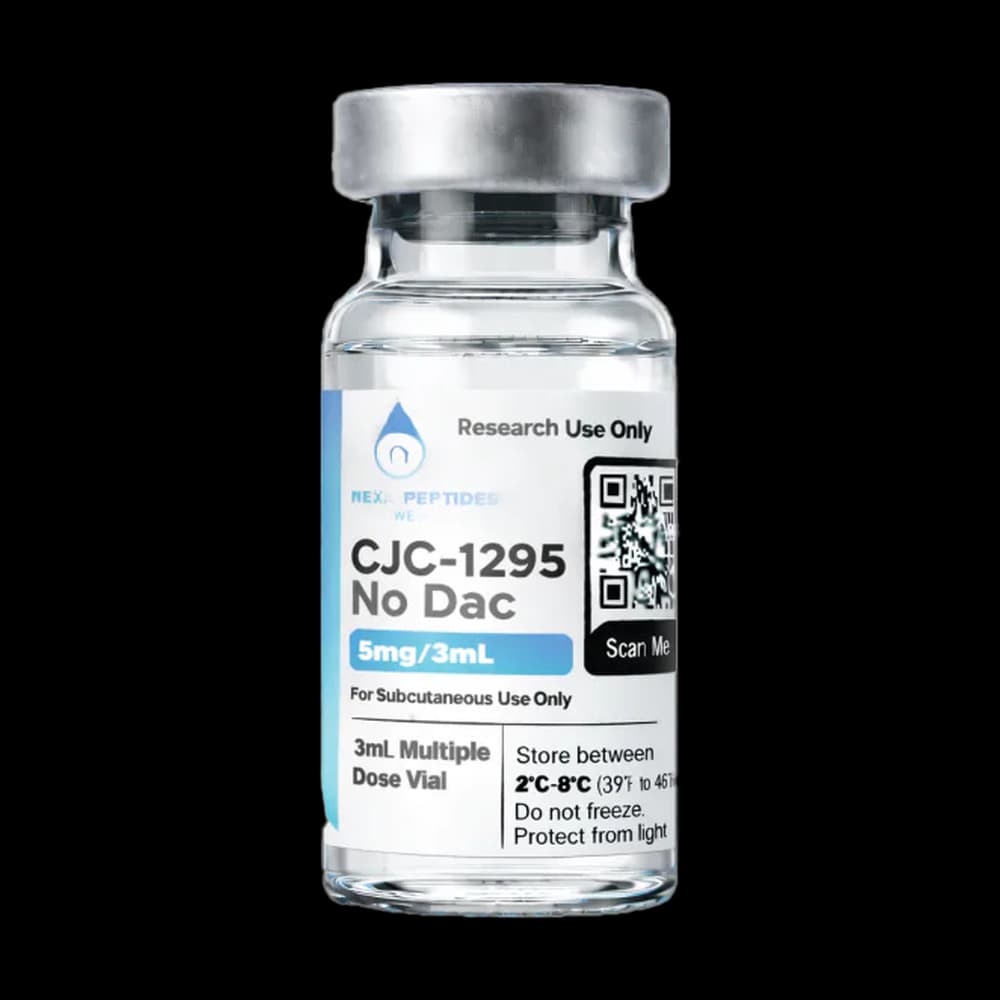
CJC-1295 (No DAC) — 5mg
SKU: NXP-CJC-5
Modified GHRH peptide studied to stimulate growth hormone release and boost IGF-1 levels by enhancing endocrine signaling pathways. For research use only.
Product Details
**For best results, this product should be reconstituted with Hospira Bacteriostatic Water, which will be automatically added to your cart. Use of any alternative diluent is at your own discretion, and we are not responsible for any resulting changes in appearance or consistency, including cloudiness or gelling of the research product.*
CJC-1295 (No DAC) is a synthetic analog of growth hormone releasing hormone (GHRH) consisting of 29 amino acids. The "No DAC" designation indicates this version lacks the Drug Affinity Complex, resulting in a shorter duration of action that more closely mimics the natural pulsatile release pattern of growth hormone.
Research has focused on CJC-1295 (No DAC) for its ability to stimulate growth hormone secretion from the anterior pituitary gland. Studies have examined its pharmacokinetic profile, receptor binding characteristics, and its effects on GH and IGF-1 levels in various research models.
Each vial contains 5mg of CJC-1295 (No DAC) in lyophilized form, manufactured to exceed 98% purity as verified by HPLC analysis. Rigorous quality control and third-party testing ensure batch-to-batch consistency for reliable research outcomes.
Store lyophilized at -20C. Reconstituted at 2-8C, use within 60 days.
For research and laboratory use only.
About CJC-1295 (No DAC)
CJC-1295 (No DAC), also known in research literature as Modified GRF (1-29) or Mod GRF (1-29), is a synthetic analogue of the endogenous peptide Growth Hormone-Releasing Hormone (GHRH). It represents a truncated version of GHRH, consisting of the first 29 amino acids, which are responsible for its biological activity. This peptide has been specifically engineered with four amino acid substitutions to enhance its stability and resistance to enzymatic degradation, thereby increasing its biological half-life compared to the native GHRH (1-29) fragment.
The structure of CJC-1295 (No DAC) is a polypeptide chain of 29 amino acids with the sequence: Tyr-Ala-Asp-Ala-Ile-Phe-Thr-Asn-Ser-Tyr-Arg-Lys-Val-Leu-Gly-Gln-Leu-Ser-Ala-Arg-Lys-Leu-Leu-Gln-Asp-Ile-Met-Ser-Arg-NH2. The key modifications are the substitution of L-Alanine at the second position with D-Alanine (D-Ala2), Glutamine at the eighth position (Gln8), Alanine at the fifteenth position (Ala15), and Leucine at the twenty-seventh position (Leu27). The D-Ala2 substitution is particularly critical as it confers resistance to cleavage by the enzyme dipeptidyl peptidase-IV (DPP-IV), which rapidly inactivates native GHRH.
The designation "No DAC" is crucial as it distinguishes this molecule from its longer-acting counterpart, CJC-1295 with DAC (Drug Affinity Complex). The absence of the DAC moiety results in a significantly shorter plasma half-life, approximately 30 minutes. This characteristic allows the peptide to induce a pulsatile release of growth hormone (GH) from the anterior pituitary, more closely mimicking the natural, physiological pattern of GH secretion. This pulsatile action is a key feature for researchers designing experiments that require a non-continuous, more biomimetic stimulation of the somatotropic axis.
For research purposes, CJC-1295 (No DAC) serves as a precise tool for investigating the GHRH-GH-IGF-1 axis. Its defined mechanism of action and enhanced stability make it a superior alternative to native GHRH for in vitro and in vivo studies exploring somatotroph function, metabolic regulation, and cellular signaling pathways governed by GH. All applications of this peptide are strictly intended for laboratory and research use only and are not for human or veterinary consumption.
Mechanism of Action
The mechanism of action for CJC-1295 (No DAC) is centered on its function as a potent and specific agonist for the Growth Hormone-Releasing Hormone receptor (GHRH-R). The GHRH-R is a class B G-protein coupled receptor (GPCR) predominantly expressed on the surface of somatotroph cells within the anterior pituitary gland. The affinity of CJC-1295 (No DAC) for this receptor is comparable to that of endogenous GHRH, but its enhanced enzymatic stability allows for more sustained receptor engagement within its pharmacokinetic window.
Upon binding to the GHRH-R, CJC-1295 (No DAC) induces a conformational change in the receptor, which facilitates the activation of its associated heterotrimeric G-protein, specifically the Gs alpha subunit (Gsα). The activated Gsα dissociates from the βγ subunit complex and stimulates the membrane-bound enzyme adenylyl cyclase. This enzyme catalyzes the conversion of adenosine triphosphate (ATP) to the second messenger cyclic adenosine monophosphate (cAMP). The subsequent elevation of intracellular cAMP levels is the primary signal transducer for GHRH-R activation.
Increased intracellular cAMP leads to the activation of Protein Kinase A (PKA). PKA is a serine/threonine kinase that phosphorylates numerous downstream targets, initiating a cascade of events culminating in GH synthesis and secretion. A critical target of PKA is the cAMP response element-binding protein (CREB). Once phosphorylated by PKA, pCREB translocates to the nucleus, where it binds to cAMP response elements (CREs) located in the promoter region of the GH1 gene. This binding event recruits transcriptional coactivators, thereby stimulating the transcription of the gene encoding growth hormone.
In addition to stimulating GH gene transcription, the signaling cascade also promotes the release of pre-synthesized GH stored in secretory granules. The PKA-mediated pathway, along with potential parallel signaling involving phospholipase C and subsequent increases in intracellular calcium (Ca2+) concentrations, facilitates the fusion of these granules with the somatotroph's cell membrane, a process known as exocytosis. This results in the release of GH into the bloodstream in a pulsatile manner.
The structural modifications of CJC-1295 (No DAC) are fundamental to its mechanism. The D-Ala substitution at position 2 sterically hinders the action of DPP-IV, the primary enzyme responsible for the rapid N-terminal degradation of native GHRH. By preventing this cleavage, the peptide's half-life is extended from under 5 minutes to approximately 30 minutes, enabling a more robust and sustained physiological response per administration in a research context. This allows researchers to study the downstream effects of a defined GH pulse in various experimental models.
Research Applications
CJC-1295 (No DAC) is a valuable investigational compound utilized in a wide range of preclinical research settings to explore the complex physiology of the growth hormone axis. Its ability to induce a pulsatile release of GH, mimicking natural secretory patterns, makes it a preferred tool for studies where sustained, supraphysiological GH levels are undesirable. Research applications span fields from endocrinology and metabolism to neurobiology and musculoskeletal science.
In the field of metabolic research, CJC-1295 (No DAC) has been used in animal models to investigate the effects of GH pulses on body composition, lipolysis, and glucose homeostasis. Studies in rodent models of obesity or metabolic dysfunction have employed this peptide to dissect the role of the GHRH-GH-IGF-1 axis in regulating adipose tissue mass, insulin sensitivity, and hepatic glucose production. These investigations aim to elucidate the molecular mechanisms by which pulsatile GH signaling influences energy balance and substrate utilization.
Cellular aging is another significant area of investigation. The GH/IGF-1 axis is known to be a key regulator of cellular growth, proliferation, and senescence. In vitro studies using cell cultures, such as fibroblasts or chondrocytes, utilize GHRH analogues like CJC-1295 (No DAC) to examine the impact of controlled GH signaling on cell cycle progression, DNA repair mechanisms, and the expression of senescence-associated markers. This research seeks to understand how hormonal signals modulate the cellular aging process at a fundamental level.
Musculoskeletal research frequently employs CJC-1295 (No DAC) in preclinical models of sarcopenia, cachexia, or muscle injury. By stimulating endogenous GH release, researchers can study its effects on muscle protein synthesis, satellite cell activation, and tissue regeneration. In these in vivo animal studies, endpoints often include measurements of muscle fiber size, contractile function, and the expression of key anabolic signaling proteins within the mTOR and PI3K/Akt pathways. Similarly, its role in bone metabolism and fracture healing has been an area of exploration in orthopedic research models.
Furthermore, the expression of GHRH receptors in the central nervous system has prompted investigations into the neurobiological effects of GHRH agonists. Preclinical studies in rodent models have used CJC-1295 (No DAC) to explore potential roles in neuroprotection, synaptic plasticity, and cognitive function, particularly in the context of aging or neurodegenerative models. These studies aim to clarify the extra-pituitary functions of GHRH signaling within the brain. All such applications are strictly for non-human, laboratory-based scientific inquiry.
Formulation & Handling
Proper handling and storage of CJC-1295 (No DAC) are critical to maintain its integrity and ensure reproducible results in a research setting. The peptide is supplied as a lyophilized (freeze-dried) white powder in a sterile vial. In its lyophilized state, it exhibits excellent stability and should be stored in a freezer at temperatures between -20°C and -80°C. Storing the powder in this manner, protected from light and moisture, preserves its structure and biological activity for extended periods.
For experimental use, the peptide must be reconstituted into a liquid solution. This should be performed under sterile conditions using an appropriate solvent, typically sterile bacteriostatic water. To reconstitute, slowly inject the desired volume of solvent down the side of the vial to avoid foaming or agitating the delicate peptide. Gently swirl or roll the vial between the fingers until the powder is completely dissolved. Vigorous shaking or vortexing should be avoided as the mechanical stress can cause denaturation and degradation of the peptide.
Once reconstituted, the peptide solution is less stable than the lyophilized powder. The solution should be stored in a refrigerator at 2°C to 8°C and is typically stable for a limited period, often a few weeks. For studies requiring long-term use, it is best practice to prepare single-use aliquots from the stock solution immediately after reconstitution. These aliquots can then be stored frozen at -20°C or lower. This practice minimizes waste and prevents degradation associated with repeated freeze-thaw cycles and exposure to proteases. Always use sterile syringes and techniques when handling the reconstituted solution to prevent microbial contamination.
Quality Standards
Nexa Peptides is committed to providing researchers with the highest quality reagents for their scientific investigations. Our CJC-1295 (No DAC) is subject to a stringent quality control protocol to guarantee its purity, identity, and suitability for research applications. Each batch is meticulously analyzed to ensure it meets our exacting standards before being made available to the scientific community.
The purity of our CJC-1295 (No DAC) is determined using High-Performance Liquid Chromatography (HPLC). This analytical technique separates the target peptide from any potential impurities, allowing for precise quantification. We guarantee a purity level of greater than 99% for every batch. Concurrently, the peptide's identity and molecular weight are confirmed using Mass Spectrometry (MS). This analysis verifies that the peptide has the correct amino acid sequence and molecular mass (approximately 3367.9 g/mol), ensuring that researchers receive the correct compound.
Our peptides are synthesized in facilities that operate under cGMP (Current Good Manufacturing Practice) guidelines. Furthermore, each batch undergoes testing for endotoxin levels to ensure it is free from pyrogenic contaminants that could interfere with in vitro or in vivo experiments. To provide full transparency, every purchase is accompanied by a lot-specific Certificate of Analysis (CoA). This document provides the complete results of our third-party testing, including the HPLC chromatogram and MS data, and confirms that the product meets our quality specifications. This commitment to quality and traceability ensures that our research peptides serve as reliable and consistent tools for scientific discovery. All products are sold for Research Use Only.
Frequently Asked Questions
What is CJC-1295 (No DAC)?
How is CJC-1295 (No DAC) synthesized?
What is the molecular weight of CJC-1295 (No DAC)?
What research areas use CJC-1295 (No DAC)?
How should CJC-1295 (No DAC) be stored?
How should CJC-1295 (No DAC) be reconstituted for research?
What purity grade is Nexa Peptides' CJC-1295 (No DAC)?
Is CJC-1295 (No DAC) available with a Certificate of Analysis?
Explore Related Research
Customer Reviews
5 reviews
Hannah H.Verified PurchaseMay 25, 2026
Workouts have felt stronger and my sleep quality is the best it has been in years.
Chris W.May 24, 2026
Packed carefully with cold packs and it arrived in great shape despite the heat this week.
Heather A.Verified PurchaseMay 20, 2026
Steady gains in recovery and sleep without anything dramatic or harsh. Exactly what I wanted.
Brian W.Verified PurchaseMay 10, 2026
I was skeptical about ordering online but the whole process was professional from start to finish. Clear product info, fast checkout, discreet shipping, and the vials arrived properly sealed.
Sofia C.Verified PurchaseApr 12, 2026
Did my homework before ordering and this company has the reputation to back it up. It lived up to it.