
Sexual Health
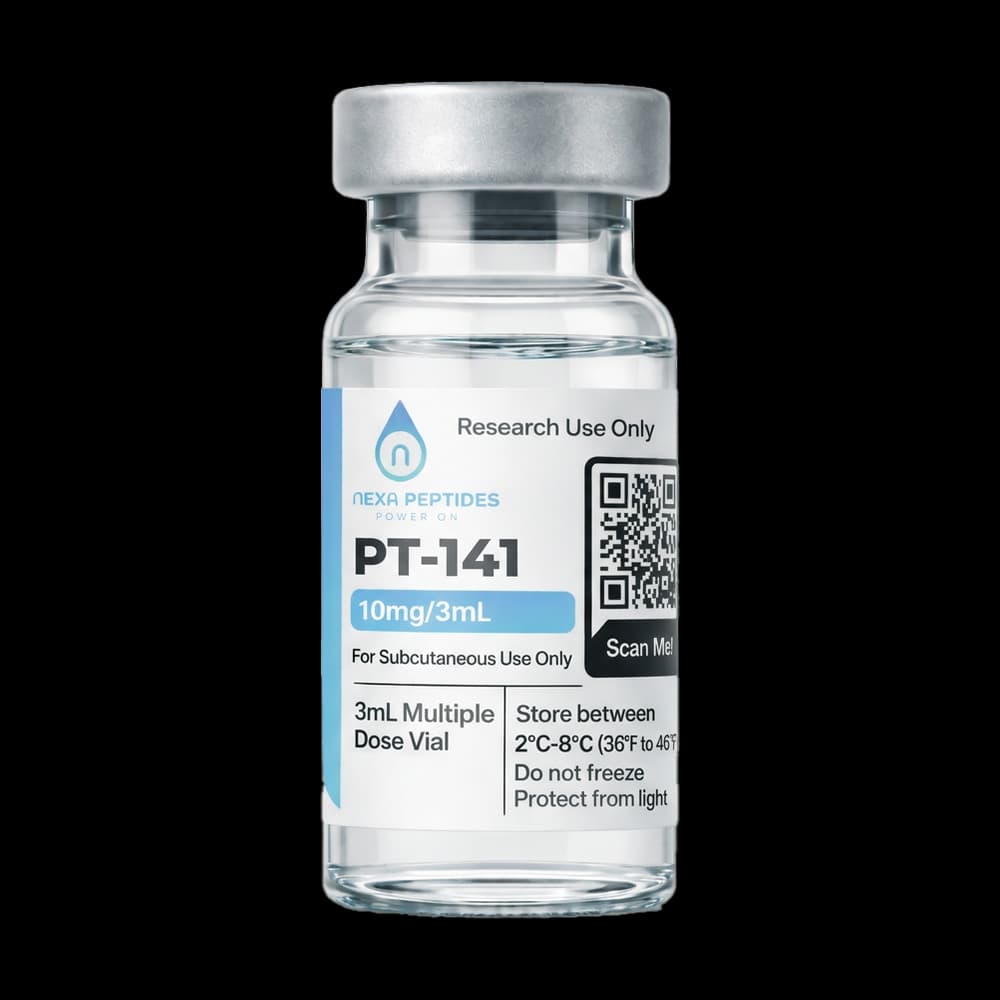
PT-141 (Bremelanotide) — PT-141 10mg
SKU: NXP-PT14-01
Product Details
PT-141, also known as Bremelanotide, is a cyclic heptapeptide melanocortin receptor agonist that acts primarily through the MC3 and MC4 receptors in the central nervous system. Unlike PDE5 inhibitors that act peripherally on vascular tissue, PT-141 works through neural pathways involved in sexual arousal and desire.
Research has explored PT-141 for its unique mechanism of action on melanocortin signaling and its effects on sexual function in both male and female research models. Clinical studies have demonstrated its ability to increase measures of sexual desire and arousal through central nervous system activation rather than direct vascular effects.
Each vial contains PT-141 in lyophilized form, manufactured to a purity exceeding 98% as confirmed by HPLC analysis and mass spectrometry. All batches undergo independent third-party verification for identity, purity, and potency.
Store lyophilized at -20C. Reconstituted at 2-8C, use within 60 days.
For research and laboratory use only.
About PT-141 (Bremelanotide)
PT-141, known scientifically as Bremelanotide, is a synthetic heptapeptide and a potent analog of the endogenous peptide hormone alpha-melanocyte-stimulating hormone (α-MSH). Its chemical structure is Ac-Nle-cyclo[Asp-His-D-Phe-Arg-Trp-Lys]-OH. PT-141 is notable in the research community as a key metabolite of Melanotan II, from which it was derived. Critically, it lacks the C-terminal amide group present in Melanotan II, a structural modification that significantly alters its receptor binding profile and subsequent biological activity investigated in laboratory settings.
This unique structural distinction makes PT-141 a highly selective ligand for specific melanocortin receptors. While α-MSH and Melanotan II are non-selective agonists across multiple melanocortin receptor subtypes, PT-141 exhibits primary agonism at the melanocortin-3 (MC3R) and melanocortin-4 receptors (MC4R), with substantially less affinity for the melanocortin-1 receptor (MC1R). This selectivity is of high interest to researchers, as MC1R is primarily responsible for stimulating melanin production (melanogenesis) in skin melanocytes. By minimizing MC1R activation, PT-141 allows for the isolated investigation of MC3R and MC4R-mediated pathways in the central nervous system without the confounding variable of significant pigmentary changes observed with less selective analogs.
Consequently, PT-141 has become an invaluable tool for neuroscientists, endocrinologists, and physiologists studying the intricate CNS pathways that govern complex behaviors. Its application in preclinical models enables the exploration of centrally mediated processes, including sexual arousal, appetite regulation, and metabolic homeostasis. As a research compound, PT-141 provides a precise mechanism for probing the functional roles of hypothalamic MC3R and MC4R signaling cascades. All products, including PT-141, are supplied by Nexa Peptides strictly for in vitro laboratory research and are not intended for human consumption. The insights gained from such studies contribute to a fundamental understanding of neuropeptide signaling in physiological regulation.
Mechanism of Action
The mechanism of action for PT-141 (Bremelanotide) is centered on its function as a potent agonist at specific subtypes of the melanocortin receptor (MCR) family, particularly the melanocortin-3 receptor (MC3R) and melanocortin-4 receptor (MC4R). These receptors are G protein-coupled receptors (GPCRs) predominantly expressed in the central nervous system, including key regions of the hypothalamus such as the paraventricular nucleus (PVN) and the medial preoptic area (mPOA), which are integral to regulating energy homeostasis and sexual behavior.
Upon binding to MC3R and MC4R, PT-141 initiates a canonical GPCR signaling cascade. The peptide-receptor complex catalyzes the exchange of GDP for GTP on the associated Gs alpha subunit of the heterotrimeric G protein. This activation causes the Gs alpha subunit to dissociate and stimulate the membrane-bound enzyme adenylyl cyclase. Activated adenylyl cyclase then catalyzes the conversion of adenosine triphosphate (ATP) into the second messenger cyclic adenosine monophosphate (cAMP). This amplification step is a hallmark of GPCR signaling, allowing a small number of receptor activation events to generate a robust intracellular response.
The subsequent rise in intracellular cAMP levels leads to the activation of Protein Kinase A (PKA). PKA is a serine/threonine kinase that phosphorylates a multitude of downstream protein targets within the neuron. One of the most critical targets in this pathway is the cAMP response element-binding protein (CREB). Phosphorylated CREB translocates to the nucleus, where it binds to specific DNA sequences known as cAMP response elements (CREs) in the promoter regions of target genes, thereby modulating gene transcription. This cascade ultimately alters neuronal excitability, neurotransmitter release, and synaptic plasticity in the targeted brain circuits.
The molecular structure of PT-141, a cyclic heptapeptide with a molecular weight of 1025.2 g/mol, is optimized for stability and receptor affinity. The inclusion of a D-phenylalanine residue and the cyclic structure confer resistance to enzymatic degradation, prolonging its activity in research models. Importantly, the mechanism of PT-141 is distinct from that of peripherally acting agents. Its activity is centrally mediated, initiating signaling within the brain to modulate downstream physiological responses. This central action makes it a specific tool for researchers aiming to dissect the neural circuits governing sexual motivation and arousal, distinguishing these CNS-driven processes from peripheral vascular mechanics. All investigations using PT-141 are conducted in controlled laboratory environments for research purposes only.
Research Applications
PT-141 (Bremelanotide) is a specialized peptide utilized exclusively in preclinical research settings to investigate the neurobiological basis of sexual function, desire, and metabolic control. Its primary application is in the field of neuroscience, where it serves as a pharmacological tool to probe the role of central melanocortin pathways in regulating complex behaviors. In numerous in vivo animal models, typically involving rodents such as rats and mice, researchers have administered PT-141 to study its effects on centrally mediated sexual arousal. These studies often measure behavioral endpoints, such as lordosis behavior in female models or erectile responses in male models, to characterize the function of MC3R and MC4R activation within the hypothalamus and other relevant brain regions.
Another significant area of research involves the use of PT-141 in animal models designed to study hypoactive sexual desire disorder (HSDD). By activating melanocortin receptors in the brain, researchers can explore the neural circuits that underlie sexual motivation and receptivity. These investigations help to elucidate the intricate interplay of neuropeptides, hormones, and neurotransmitters in the regulation of libido, providing fundamental insights into the physiology of sexual desire. The central mechanism of PT-141 is particularly valuable in these studies, as it allows for the differentiation between central motivational states and peripheral physiological capabilities.
Beyond sexual function, PT-141 is also employed in metabolic research. The MC4R is a well-established and critical regulator of energy balance, food intake, and body weight. Studies in animal models utilize PT-141 to investigate how activation of this receptor influences appetite and energy expenditure. By observing changes in feeding behavior and metabolic parameters following PT-141 administration, scientists can further delineate the role of the central melanocortin system in metabolic homeostasis and its potential overlap with pathways regulating other motivated behaviors. These studies are crucial for understanding the complex hypothalamic integration of various physiological drives.
Furthermore, some research explores the broader effects of melanocortin agonism on the cardiovascular and autonomic nervous systems. Preclinical studies have examined how central MC4R activation by agents like PT-141 can influence parameters such as blood pressure and heart rate. This line of inquiry helps to map the connections between hypothalamic control centers and peripheral autonomic outflow. It is imperative to note that all these applications are strictly confined to non-human, laboratory-based research. The findings are intended to advance scientific knowledge and are not indicative of any approved clinical use. This product is for Research Use Only.
Formulation & Handling
For optimal stability and integrity, lyophilized PT-141 (Bremelanotide) powder should be stored in a freezer at or below -20°C. This long-term storage condition minimizes degradation and preserves the peptide's structure until it is ready for use in a research protocol. For short-term storage prior to reconstitution, refrigeration at 2-8°C is acceptable. The vial should be kept sealed and protected from direct light to prevent photo-degradation.
Reconstitution of the lyophilized peptide must be performed under sterile conditions using appropriate laboratory techniques. The recommended diluent is bacteriostatic water containing 0.9% benzyl alcohol, which helps maintain sterility for multiple uses from the same vial. To reconstitute, slowly inject the desired volume of diluent down the side of the glass vial, taking care to avoid direct contact with the lyophilized powder. Do not shake the vial vigorously, as this can cause shearing and denaturation of the peptide. Instead, gently swirl or roll the vial between the palms until the powder is fully dissolved, resulting in a clear solution.
Once reconstituted, the PT-141 solution should be stored refrigerated at 2-8°C and is typically stable for several weeks. For research protocols extending over a longer period, it is best practice to aliquot the reconstituted solution into smaller, single-use volumes and store them frozen at -20°C or -80°C. This approach prevents repeated freeze-thaw cycles, which can significantly degrade the peptide and compromise experimental results. Always use appropriate personal protective equipment (PPE), including gloves and a lab coat, when handling this research compound. This product is intended for Research Use Only.
Quality Standards
At Nexa Peptides, we are committed to providing researchers with the highest quality compounds to ensure the validity and reproducibility of their scientific investigations. Every batch of our PT-141 (Bremelanotide) is subjected to a rigorous quality control process. Purity is a critical parameter, and we guarantee a minimum purity level of >99% as determined by High-Performance Liquid Chromatography (HPLC). This analytical technique separates, identifies, and quantifies each component in the mixture, ensuring that the final product is free from significant impurities or synthesis-related byproducts.
To confirm the identity and structural integrity of the peptide, each batch undergoes Mass Spectrometry (MS) analysis. This method verifies the molecular weight of PT-141, confirming that the correct amino acid sequence has been synthesized and that the peptide has the expected mass. This verification step is crucial for ensuring the compound will interact with its intended molecular targets as expected in a research setting. Furthermore, we conduct testing for bacterial endotoxins to ensure that our peptides are suitable for sensitive in vitro cell culture and in vivo animal model studies, preventing interference from non-specific inflammatory responses.
Our PT-141 is synthesized in a facility that adheres to cGMP (Current Good Manufacturing Practice) standards, ensuring that every step of the manufacturing process is controlled and documented for consistency and quality. For complete transparency, a third-party Certificate of Analysis (COA) is available for every lot. This document provides detailed results from HPLC and MS analyses, as well as other quality metrics. Full lot traceability ensures that researchers can achieve consistent and reproducible results across different experiments and purchase orders. All our products are supplied for Research Use Only.
Frequently Asked Questions
What is PT-141 (Bremelanotide)?
How is PT-141 (Bremelanotide) synthesized?
What is the molecular weight of PT-141 (Bremelanotide)?
What research areas use PT-141 (Bremelanotide)?
How should PT-141 (Bremelanotide) be stored?
How should PT-141 (Bremelanotide) be reconstituted for research?
What purity grade is Nexa Peptides' PT-141 (Bremelanotide)?
Is PT-141 (Bremelanotide) available with a Certificate of Analysis?
Explore Related Research
Customer Reviews
4 reviews
Roy F.Verified PurchaseMay 26, 2026
Great product, fast shipping. Will reorder.
Nathan H.May 10, 2026
Smooth checkout, quick shipping, accurate order. Nothing flashy, just done well.
Omar T.Apr 3, 2026
Shipping was quick and everything was exactly as listed. Simple and reliable.
MouyMar 25, 2026
Helps improve sexual libido in ways I never knew could be improved upon! Highly recommend!!