
Sexual Health
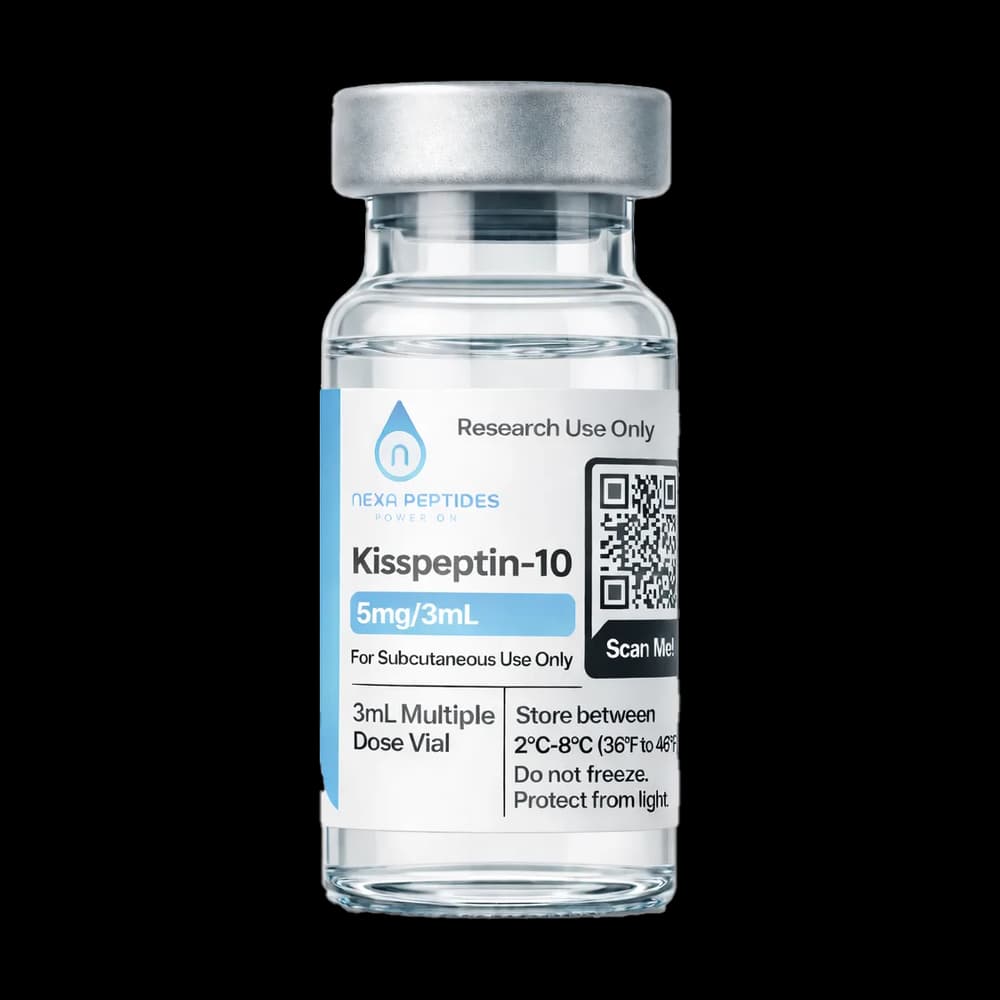
Kisspeptin-10 — 5mg
SKU: NXP-KISS-05
Kisspeptin-10 regulates the secretion of gonadotropin-releasing hormone (GnRH) and plays a key role in controlling the reproductive axis. In experimental models, it is involved in the synthesis and regulation of reproductive hormones. For Research Use Only
Product Details
Kisspeptin-10 is a synthetic peptide, derived from the Kiss1 gene, consisting of a 10-amino acid sequence. It serves as a potent ligand for the G-protein-coupled receptor, GPR54, which activates the hypothalamic-pituitary-gonadal axis in research models. Kisspeptin-10 regulates gonadotropin-releasing hormone (GnRH) secretion and plays a crucial role in the modulation of the reproductive axis. In experimental studies, it influences the synthesis of reproductive hormones. Additionally, Kisspeptin-10 has been explored for its impact on neuroendocrine signaling and potential modulation of metabolic processes, making it an essential tool in endocrinological research.
About Kisspeptin-10
Kisspeptin-10 is a synthetic decapeptide that represents the shortest, fully active C-terminal fragment of the native kisspeptin protein (Kiss1). Its amino acid sequence is Tyr-Asn-Trp-Asn-Ser-Phe-Gly-Leu-Arg-Phe-NH2 (YNWNSFGLRF-NH2), classifying it as a member of the RF-amide peptide family due to its characteristic C-terminal arginine-phenylalanine-amide motif. This structural feature is critical for its biological activity. Kisspeptin-10 is renowned in the scientific community as the primary endogenous agonist for the G protein-coupled receptor 54 (GPR54), now more formally known as KISS1R. The discovery of the Kiss1 gene and its peptide products revolutionized the field of neuroendocrinology, revealing a master regulator of the reproductive axis.
The significance of Kisspeptin-10 in laboratory research stems from its potent and specific action on hypothalamic neurons that express KISS1R. These neurons are primarily responsible for secreting gonadotropin-releasing hormone (GnRH), the principal hormone that governs the entire hypothalamic-pituitary-gonadal (HPG) axis. By potently stimulating GnRH release, Kisspeptin-10 acts as a critical upstream regulator of puberty onset, ovulation, and the maintenance of normal reproductive function in various preclinical models. Its well-defined structure and mechanism make it an invaluable molecular tool for investigators studying the complex interplay between neural signaling and endocrine regulation.
Originally, the KISS1 gene was identified for its role as a metastasis suppressor in melanoma cell lines, highlighting a separate avenue of research interest in oncology. However, its profound effects on the HPG axis have since become the dominant focus of investigation. Researchers utilize Kisspeptin-10 in a wide array of experimental settings, from in vitro cell culture assays to in vivo animal models, to dissect the molecular pathways controlling fertility, explore potential links between metabolism and reproduction, and investigate the mechanisms of cancer metastasis. As a research-grade compound, Kisspeptin-10 provides a reliable and consistent tool for probing these fundamental biological processes.
For Research Use Only. This product is not intended for human consumption or for use in any diagnostic or therapeutic procedures.
Mechanism of Action
The mechanism of action of Kisspeptin-10 is mediated primarily through its high-affinity binding to and activation of the KISS1 receptor (KISS1R), formerly known as G protein-coupled receptor 54 (GPR54). KISS1R is predominantly expressed on the surface of gonadotropin-releasing hormone (GnRH) neurons located within specific regions of the hypothalamus, including the arcuate nucleus (ARC) and the anteroventral periventricular nucleus (AVPV). Upon binding, Kisspeptin-10 induces a conformational change in the KISS1R, initiating a canonical Gαq/11 signal transduction cascade, which is the cornerstone of its physiological effect on the reproductive axis.
Activation of the Gαq/11 subunit triggers the downstream enzyme phospholipase C (PLC). PLC, in turn, catalyzes the hydrolysis of the membrane phospholipid phosphatidylinositol 4,5-bisphosphate (PIP2) into two crucial second messengers: inositol 1,4,5-trisphosphate (IP3) and diacylglycerol (DAG). IP3 diffuses through the cytoplasm and binds to IP3 receptors on the endoplasmic reticulum, prompting the rapid release of stored intracellular calcium (Ca2+) into the cytosol. Concurrently, DAG remains in the plasma membrane and, along with the elevated cytosolic Ca2+, activates various isoforms of protein kinase C (PKC).
The synergistic action of increased intracellular Ca2+ and PKC activation leads to a profound depolarization of the GnRH neuron's cell membrane. This is achieved through the modulation of ion channel activity, including the opening of transient receptor potential canonical (TRPC) channels and the closure of inwardly rectifying potassium (Kir) channels. The resulting increase in neuronal excitability triggers a burst of action potentials, culminating in the pulsatile secretion of GnRH from the neuron terminals into the hypophyseal portal circulation. This precise, pulse-driven release is critical for proper downstream signaling.
Once released, GnRH travels to the anterior pituitary gland, where it binds to its own receptor on gonadotroph cells. This interaction stimulates the synthesis and co-secretion of two essential gonadotropins: luteinizing hormone (LH) and follicle-stimulating hormone (FSH). These hormones enter the systemic circulation and act on the gonads (testes and ovaries) to regulate gametogenesis and steroidogenesis. Beyond this primary pathway, research in other cell types, such as cancer cell lines, has suggested that KISS1R activation can also engage other signaling pathways, including the mitogen-activated protein kinase (MAPK/ERK) pathway, which may underlie its observed anti-metastatic properties in experimental models. The study of Kisspeptin-10 provides a powerful means to investigate these intricate signaling networks in controlled laboratory environments.
Research Applications
Kisspeptin-10 is a pivotal tool in a range of advanced research applications, primarily centered on neuroendocrinology, reproductive biology, and oncology. Its most prominent use is in studies investigating the regulation of the hypothalamic-pituitary-gonadal (HPG) axis. Researchers employ Kisspeptin-10 in both in vivo animal models (e.g., rodents, sheep, non-human primates) and in vitro hypothalamic explant cultures to elucidate its role as the master regulator of gonadotropin-releasing hormone (GnRH) secretion. These studies aim to understand the fundamental mechanisms governing puberty onset, the neuroendocrine control of ovulation and the menstrual/estrous cycle, and the feedback loops involving gonadal steroids.
In the field of reproductive science, Kisspeptin-10 is used to model and investigate conditions of HPG axis dysfunction. For instance, preclinical studies utilize Kisspeptin-10 to explore its effects in animal models of hypogonadotropic hypogonadism, polycystic ovary syndrome (PCOS), and stress-induced reproductive suppression. By administering Kisspeptin-10 in controlled laboratory settings, researchers can assess its capacity to modulate GnRH pulse frequency and amplitude, thereby restoring downstream gonadotropin secretion and gonadal function in these models. This allows for a detailed examination of the kisspeptin system's role in both physiological and pathophysiological states.
Another significant area of research is the intersection of metabolism and reproduction. The kisspeptin system is believed to be a key conduit through which metabolic cues, such as leptin and insulin signaling, influence reproductive capability. Laboratory investigations use Kisspeptin-10 to probe how nutritional status and energy balance impact GnRH neuronal activity. These studies in animal models are critical for understanding how metabolic disorders can lead to reproductive deficits and for mapping the neural circuits that integrate these two essential physiological systems.
Beyond endocrinology, Kisspeptin-10 is studied in oncology research due to the original discovery of its parent gene, KISS1, as a metastasis suppressor. In vitro studies using various cancer cell lines (e.g., melanoma, breast, and pancreatic cancer) investigate the ability of Kisspeptin-10 to inhibit cell migration, invasion, and adhesion through the KISS1R. These cellular and molecular biology studies aim to dissect the signaling pathways, such as the suppression of matrix metalloproteinases or modulation of the focal adhesion kinase (FAK) pathway, that contribute to these anti-metastatic effects. Such research provides valuable insights into the fundamental processes of cancer progression.
Formulation & Handling
For optimal stability and integrity, lyophilized Kisspeptin-10 should be stored in a freezer at or below -20°C. When stored under these conditions, the peptide remains stable for an extended period. For short-term storage prior to reconstitution, refrigeration at 2-8°C is acceptable for several weeks. It is crucial to protect the lyophilized powder from moisture and direct light.
Reconstitution should be performed under sterile conditions using appropriate laboratory techniques. The recommended solvent for reconstitution is sterile bacteriostatic water (containing 0.9% benzyl alcohol) for studies involving multiple experimental time points, as it helps prevent microbial growth. Alternatively, sterile deionized water or a suitable sterile buffer can be used for immediate, single-use applications. To reconstitute, slowly inject the desired volume of solvent down the side of the vial. Gently swirl or roll the vial to dissolve the powder completely; avoid vigorous shaking or vortexing, as this can cause aggregation and degradation of the peptide.
Once reconstituted, the Kisspeptin-10 solution should be stored at 2-8°C and is typically stable for a limited duration. For long-term research protocols, it is best practice to aliquot the reconstituted solution into single-use volumes and store them frozen at -20°C or -80°C. This practice minimizes the number of freeze-thaw cycles, which can significantly compromise peptide integrity and experimental reproducibility. Always use sterile, properly-labeled tubes for aliquoting.
Quality Standards
At Nexa Peptides, we are committed to providing researchers with the highest quality tools for their scientific investigations. Our Kisspeptin-10 is synthesized and supplied with a guaranteed purity level exceeding 99%, as rigorously determined by High-Performance Liquid Chromatography (HPLC). This analytical technique separates, identifies, and quantifies each component in the mixture, ensuring that the final product is free from significant impurities or synthesis-related byproducts, which is critical for obtaining accurate and reproducible experimental results.
To ensure the identity and structural integrity of our Kisspeptin-10, each batch undergoes verification via Mass Spectrometry (MS). This analysis confirms that the molecular weight of the peptide corresponds precisely to its amino acid sequence (YNWNSFGLRF-NH2), providing confidence in its chemical identity. Furthermore, our peptides are tested for endotoxin levels to ensure they are suitable for sensitive in vitro cell culture and in vivo animal model research, minimizing the risk of non-specific inflammatory responses that could confound experimental outcomes.
All our peptides, including Kisspeptin-10, are manufactured in the USA in cGMP (Current Good Manufacturing Practice)-compliant laboratories, adhering to strict quality control protocols throughout the synthesis and purification process. For complete transparency, a third-party Certificate of Analysis (COA) is available for every lot, detailing the results of HPLC and MS analyses. This commitment to quality and documentation ensures lot-to-lot consistency and provides researchers with the reliable, high-purity compounds necessary for advancing scientific discovery.
Frequently Asked Questions
What is Kisspeptin-10?
How is Kisspeptin-10 synthesized?
What is the molecular weight of Kisspeptin-10?
What research areas use Kisspeptin-10?
How should Kisspeptin-10 be stored?
How should Kisspeptin-10 be reconstituted for research?
What purity grade is Nexa Peptides' Kisspeptin-10?
Is Kisspeptin-10 available with a Certificate of Analysis?
Explore Related Research
Customer Reviews
4 reviews
Vince E.Verified PurchaseMay 24, 2026
No issues whatsoever. Quiet packaging, quick delivery, and it works.
Rachel J.Verified PurchaseMay 11, 2026
Fast, low key, and it delivered. Will be a repeat customer.
Scott B.Verified PurchaseApr 14, 2026
Solid all around. The only reason it is not five stars is that one vial showed up with a slightly dented cap. The contents were perfectly fine.
Emma A.Apr 11, 2026
Fair pricing without cutting corners on quality. That balance is hard to find.