
Weight Loss
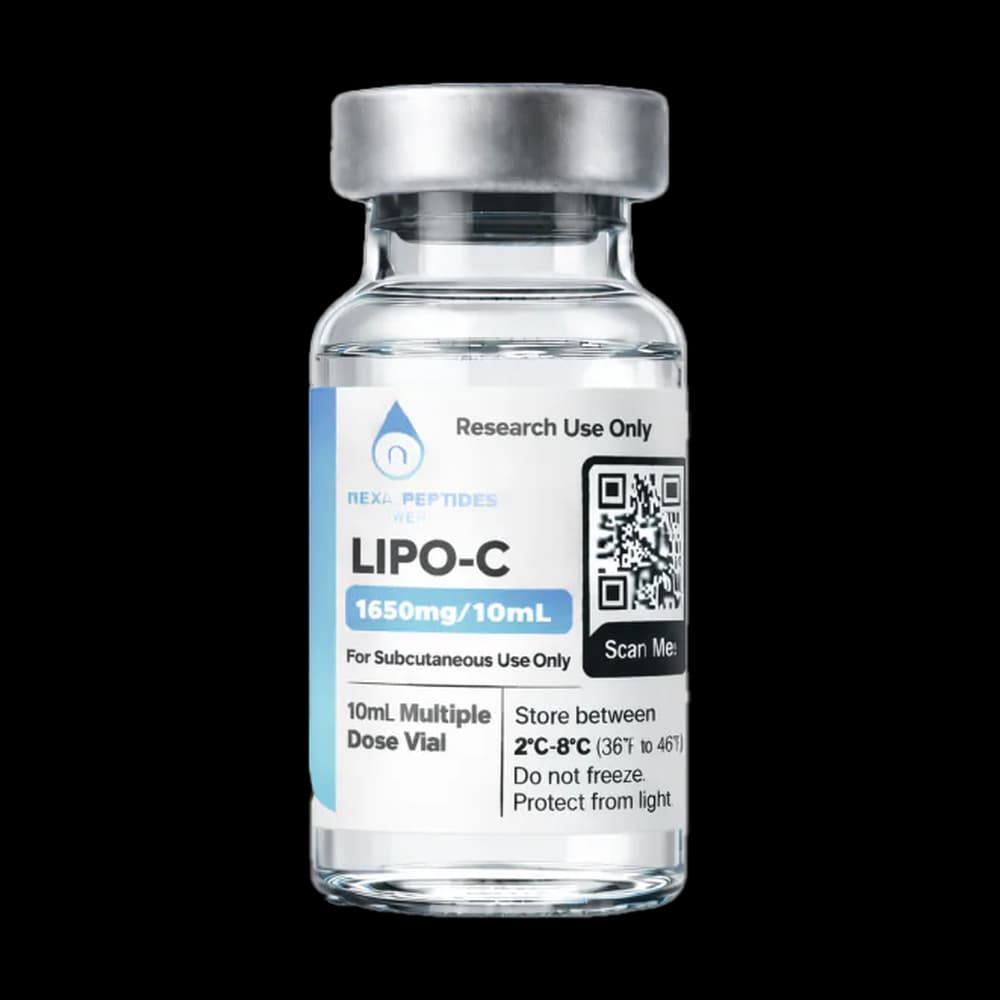
Lipo-C (Methionine/Inositol/Choline + B12) — Lipo-C (B12 & Amino Mix) 1650 mg
SKU: NXP-LIPOC-1650
Metabolic support blend combining B12, amino acids, and carnitine for energy and fat-focused optimization protocols. FOR RESEARCH USE ONLY..
Product Details
The Lipo-C formula is a research-grade metabolic support blend combining lipotropic compounds with methylcobalamin (B12) and a selection of amino acids. This combination has been developed for studies examining synergistic effects on cellular energy metabolism and lipid processing pathways.
Key components include methionine, inositol, choline, and methylcobalamin, each selected for their established roles in methyl donation, phospholipid synthesis, and mitochondrial energy production. Research protocols have used similar formulations to investigate fat transport mechanisms, hepatic lipid clearance, and one-carbon metabolism. The amino acid components support investigations into homocysteine metabolism and transsulfuration pathways.
Each vial contains 10mg of lyophilized blend, produced under GMP conditions. All individual components are tested for purity, and the final blend undergoes HPLC verification to confirm the stated composition. Certificate of analysis available upon request.
Storage: Store lyophilized at -20°C. Reconstituted at 2-8°C, use within 60 days.
For research and laboratory use only.
About Lipo-C (Methionine/Inositol/Choline + B12)
Lipo-C (Methionine/Inositol/Choline + B12) is a high-purity, multi-component formulation designed for advanced laboratory research into metabolic pathways and cellular energetics. This research tool combines three lipotropic agents—Methionine, Inositol, and Choline—with Vitamin B12 (typically as cyanocobalamin or methylcobalamin) to provide a synergistic system for investigating lipid metabolism. Each component has a distinct and well-characterized biochemical role, and their combination allows for the study of complex interactions within cellular metabolic networks. Methionine is an essential sulfur-containing amino acid (C5H11NO2S) that serves as a crucial precursor for S-adenosylmethionine (SAMe), a universal methyl donor involved in over 100 biochemical reactions, including the synthesis of carnitine, which is essential for fatty acid transport.
Inositol (C6H12O6), a carbocyclic sugar, is a fundamental structural component of eukaryotic cell membranes in the form of phosphatidylinositol. It also acts as a second messenger precursor in critical signal transduction pathways, such as the PI3K/Akt pathway, which governs cellular growth, proliferation, and glucose metabolism. Choline, an essential nutrient, is a precursor to the neurotransmitter acetylcholine and the membrane phospholipid phosphatidylcholine. Its role in synthesizing and exporting very-low-density lipoproteins (VLDL) from the liver makes it a key molecule of interest in studies of hepatic lipid homeostasis. The inclusion of Vitamin B12, a complex organometallic compound, provides a critical cofactor for enzymes like methionine synthase, directly linking it to the methionine cycle and folate metabolism, as well as fatty acid oxidation.
This formulation is of significant interest to researchers investigating the cellular and molecular mechanisms underlying metabolic disorders, particularly non-alcoholic fatty liver disease (NAFLD) and insulin resistance. By providing these key metabolic substrates and cofactors in a single, quality-controlled solution, Nexa Peptides enables researchers to conduct precise and reproducible experiments in cell culture systems and preclinical animal models. The Lipo-C formulation serves as a valuable reagent for elucidating the intricate regulation of lipid transport, methyl group donation, and signal transduction cascades that maintain metabolic homeostasis. All research conducted with this product is intended for laboratory investigation only and is not for human or veterinary use.
Mechanism of Action
The mechanism of action of the Lipo-C formulation is multifaceted, reflecting the distinct yet interconnected biochemical roles of its four components. The primary focus of this combination in a research context is the modulation of lipid metabolism, particularly within hepatocytes, through synergistic effects on methylation, signal transduction, and lipoprotein assembly.
Methionine's primary role is within the methionine cycle, where it is converted to S-adenosylmethionine (SAMe). SAMe is the principal methyl group donor in the cell, participating in the methylation of DNA, proteins, and lipids, thereby regulating gene expression and enzyme function. Critically for lipid metabolism, SAMe is required for the synthesis of phosphatidylcholine (PC) via the phosphatidylethanolamine N-methyltransferase (PEMT) pathway. Furthermore, methionine contributes to the synthesis of glutathione, a primary cellular antioxidant, and carnitine, which is indispensable for the transport of long-chain fatty acids into the mitochondria for β-oxidation. Deficiencies in this pathway are studied in models of hepatic steatosis.
Choline exerts its lipotropic effect primarily through its role as a precursor for PC synthesis via the CDP-choline pathway. PC is an obligatory component of very-low-density lipoprotein (VLDL) particles. In preclinical models, an adequate supply of choline is essential for the assembly and secretion of VLDL from the liver, a process that exports triglycerides and prevents their intracellular accumulation. By providing an exogenous source of choline, researchers can investigate the direct impact on VLDL secretion rates and the subsequent amelioration of hepatic lipid accumulation in cellular and animal models of NAFLD.
Inositol's mechanism is centered on its function as a precursor to phosphoinositides, key signaling molecules. Phosphatidylinositol (4,5)-bisphosphate (PIP2) is hydrolyzed to generate the second messengers inositol trisphosphate (IP3) and diacylglycerol (DAG), which regulate intracellular calcium levels and activate Protein Kinase C (PKC), respectively. Moreover, PIP2 is a substrate for phosphoinositide 3-kinase (PI3K), forming phosphatidylinositol (3,4,5)-trisphosphate (PIP3), a critical docking site for proteins in the insulin signaling pathway, including Akt (Protein Kinase B). By modulating the availability of inositol, researchers can study perturbations in the PI3K/Akt/mTOR pathway, which has profound implications for glucose uptake, glycogen synthesis, and cell survival.
Vitamin B12 functions as an essential cofactor for two enzymes central to this metabolic network. Methionine synthase utilizes methylcobalamin to catalyze the remethylation of homocysteine to methionine, directly replenishing the methionine pool and linking one-carbon metabolism with the folate cycle. The second enzyme, L-methylmalonyl-CoA mutase, requires adenosylcobalamin to convert L-methylmalonyl-CoA to succinyl-CoA, a key intermediate in the Krebs cycle. This reaction is vital for the catabolism of odd-chain fatty acids and certain amino acids. In a research setting, B12 ensures these pathways are not rate-limiting, allowing for a clearer investigation of the effects of the lipotropic agents themselves.
Research Applications
The Lipo-C (Methionine/Inositol/Choline + B12) formulation is a specialized tool utilized in a range of preclinical research applications, primarily centered on cellular and systemic metabolism. Its principal application is in the study of metabolic syndrome and its hepatic manifestation, non-alcoholic fatty liver disease (NAFLD). In both *in vitro* models using hepatocyte cell lines (e.g., HepG2) and *in vivo* rodent models fed high-fat or methionine-choline deficient (MCD) diets, this formulation is used to investigate the mechanisms of hepatic steatosis. Researchers study its potential to enhance the export of triglycerides from the liver by promoting VLDL synthesis and secretion, thereby reducing intracellular lipid droplet accumulation. These studies often involve quantitative lipidomics, gene expression analysis of lipogenic and lipolytic enzymes, and histological examination of liver tissue.
Another significant area of investigation is cellular energy homeostasis. The components of Lipo-C are integral to mitochondrial function. Methionine's role in carnitine synthesis and B12's involvement in the Krebs cycle are directly linked to fatty acid oxidation and ATP production. Researchers utilize this compound in studies designed to assess mitochondrial respiration rates, measure β-oxidation flux, and analyze the expression of key metabolic regulators like peroxisome proliferator-activated receptor alpha (PPARα) and AMP-activated protein kinase (AMPK). These experiments help elucidate how nutrient availability influences cellular bioenergetics and mitochondrial efficiency.
In the field of signal transduction, the inositol component makes this formulation valuable for studying pathways dependent on phosphoinositides. In cell culture experiments, researchers can modulate extracellular inositol levels to examine the downstream consequences on the PI3K/Akt/mTOR pathway. This has applications in research on insulin resistance, where impaired PI3K/Akt signaling is a key pathological feature, as well as in oncology research, where this pathway is often dysregulated. Assays may include Western blotting for phosphorylated Akt and S6 kinase, glucose uptake assays, and cell proliferation studies.
Furthermore, due to choline's role as a precursor to acetylcholine, the Lipo-C formulation is occasionally used in neuroscience research. Studies in this domain may investigate the effects of choline supplementation on acetylcholine synthesis, synaptic plasticity, and cognitive performance in animal models of neurological decline. These investigations often employ techniques such as microdialysis to measure neurotransmitter levels in specific brain regions or behavioral tests to assess memory and learning. In all applications, the Lipo-C formulation is strictly intended for laboratory research purposes to explore fundamental biochemical and physiological processes, not for any form of therapeutic or human use.
Formulation & Handling
Lipo-C (Methionine/Inositol/Choline + B12) is supplied as a sterile, pre-formulated aqueous solution intended for research use only. Proper handling and storage are critical to maintain its stability and sterility. Upon receipt, the vial should be stored under refrigerated conditions, between 2°C and 8°C (36°F and 46°F). It is imperative to protect the solution from direct light, as Vitamin B12 and other components can be light-sensitive. Do not freeze the solution, as this may compromise the integrity of the formulation and cause components to precipitate out of solution.
For laboratory use, all handling should be performed using aseptic techniques to prevent microbial contamination, especially for long-term studies requiring multiple withdrawals from the same vial. Before each use, the rubber septum of the vial should be disinfected with a 70% isopropyl alcohol wipe. Use only sterile syringes and needles to draw the required volume. After withdrawal, the vial should be promptly returned to the refrigerator. The stability of the solution after the vial has been punctured depends on strict adherence to these aseptic procedures. For extended research protocols, it may be prudent to aliquot the solution into smaller, sterile vials upon first use to minimize the risk of contamination and degradation associated with repeated access to the primary container. This product is a chemical reagent for *in vitro* and preclinical research applications and must not be used for human administration.
Quality Standards
At Nexa Peptides, we ensure that our Lipo-C (Methionine/Inositol/Choline + B12) formulation meets the highest quality standards for scientific research. Each individual raw material is subjected to rigorous identity and purity testing before formulation. The purity of each component—Methionine, Inositol, Choline, and Vitamin B12—is verified to be greater than 99% as determined by High-Performance Liquid Chromatography (HPLC). The molecular identity and integrity of each compound are confirmed using Mass Spectrometry (MS) to ensure that researchers receive precisely characterized materials for their studies.
The final product is compounded in a controlled environment following Current Good Manufacturing Practices (cGMP) guidelines to ensure consistency, stability, and sterility. The final solution undergoes testing for sterility and endotoxin levels to guarantee it is suitable for use in sensitive applications, including cell culture and preclinical animal models. Each batch of Lipo-C is accompanied by a comprehensive Certificate of Analysis (COA) that details the results of all quality control tests, including HPLC purity, MS verification, and appearance. This documentation provides full transparency and lot-to-lot traceability, enabling reproducible and reliable research outcomes. This commitment to quality ensures that our Lipo-C formulation is a dependable reagent for investigating complex metabolic pathways.
Frequently Asked Questions
What is Lipo-C (Methionine/Inositol/Choline + B12)?
How is Lipo-C (Methionine/Inositol/Choline + B12) synthesized?
What is the molecular weight of Lipo-C (Methionine/Inositol/Choline + B12)?
What research areas use Lipo-C (Methionine/Inositol/Choline + B12)?
How should Lipo-C (Methionine/Inositol/Choline + B12) be stored?
How should Lipo-C (Methionine/Inositol/Choline + B12) be reconstituted for research?
What purity grade is Nexa Peptides' Lipo-C (Methionine/Inositol/Choline + B12)?
Is Lipo-C (Methionine/Inositol/Choline + B12) available with a Certificate of Analysis?
Explore Related Research
Customer Reviews
3 reviews
Amanda H.Verified PurchaseApr 24, 2026
Had a small question before ordering and they answered quickly and clearly. That closed the sale for me.
Diane M.Apr 9, 2026
No surprises, which is the highest compliment I can give an online order. Will reorder.
Eric W.Verified PurchaseMar 18, 2026
Took a chance based on a friend's recommendation and I am glad I did. Quality has been excellent across two orders and the prices beat the couple of other places I had been using.