
Recovery
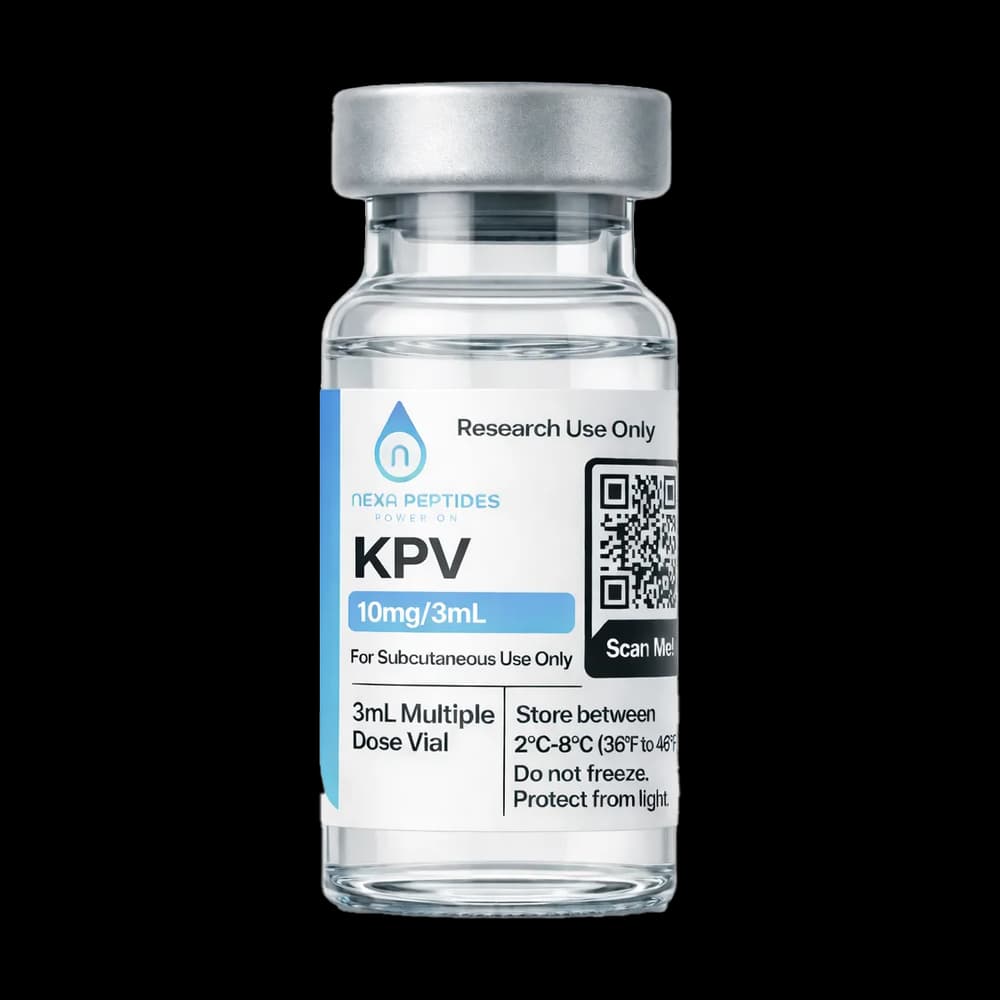
KPV — 10mg
SKU: NXP-KPV-10
KPV is a tripeptide derived from alpha-melanocyte-stimulating hormone (α-MSH), known for its potent anti-inflammatory and antimicrobial properties in research settings. Studies in animal models suggest that KPV modulates cytokine activity, supports immune regulation, and helps combat microbial pathogens. Its role in inflammation control and microbiome interactions makes it a valuable tool for exploring immune response mechanisms in non-human test subjects. RESEARCH USE ONLY
Product Details
KPV is a synthetic tripeptide composed of lysine (Lys), proline (Pro), and valine (Val), derived from alpha-melanocyte-stimulating hormone (α-MSH). In research settings, it has demonstrated potent anti-inflammatory and antimicrobial properties, making it a key focus in experimental studies involving immune modulation and microbiome interactions.
In laboratory investigations, KPV has been observed to suppress pro-inflammatory cytokines such as tumor necrosis factor-alpha (TNF-α) and interleukin-6 (IL-6) in non-human test subjects. Additionally, its antimicrobial activity against pathogens like *Staphylococcus aureus* suggests a role in supporting host defense mechanisms.
Research indicates that KPV’s bioactivity is linked to its interaction with melanocortin receptors, particularly MC1R, contributing to oxidative stress modulation and cellular homeostasis. Its stability and efficacy in experimental models highlight its potential for studying inflammation control, tissue repair, and cellular regeneration in controlled research environments.
About KPV
KPV, also known as Lysine-Proline-Valine, is a tripeptide fragment representing the C-terminal sequence of α-Melanocyte-Stimulating Hormone (α-MSH). Its amino acid sequence is Lys-Pro-Val. While α-MSH is a 13-amino acid peptide known for its role in pigmentation via the melanocortin 1 receptor (MC1R), the KPV fragment has garnered significant interest in the research community for its potent biological activities, which are functionally distinct from its parent peptide. Specifically, KPV is investigated for its profound anti-inflammatory and antimicrobial properties, which it exerts independently of the pigmentary and steroidogenic pathways associated with the full α-MSH sequence.
The small size of KPV (molecular weight approx. 342.45 g/mol) makes it an attractive molecule for preclinical studies. Its simple structure allows for straightforward synthesis and modification, enabling researchers to investigate structure-activity relationships and develop analogs for targeted research applications. Unlike larger peptides, its reduced size may facilitate improved tissue permeability in various experimental models, a key variable in topical and localized delivery system research. This has led to its extensive study in models of localized inflammation, such as those related to dermatology, gastroenterology, and ophthalmology.
At Nexa Peptides, we provide KPV synthesized to the highest standards of purity (>99%), ensuring that researchers have access to a reliable and consistent product for their studies. The peptide is supplied as a lyophilized powder, verified by mass spectrometry and HPLC, to support the integrity and reproducibility of demanding experimental protocols. As with all our products, KPV is intended strictly for in vitro and in vivo laboratory research and is not for human or veterinary use. Its unique biological profile continues to make it a valuable tool for investigators exploring the molecular mechanisms of inflammation, immune modulation, and host defense.
Mechanism of Action
The mechanism of action for KPV is multifaceted and primarily centered on the modulation of inflammatory signaling pathways. Although derived from α-MSH, a known agonist of melanocortin receptors (MCRs), KPV's anti-inflammatory effects are complex and appear to be mediated through both MCR-dependent and MCR-independent pathways. In systems expressing melanocortin receptors, particularly MC1R and MC3R, KPV can initiate signaling cascades that suppress inflammatory responses. Activation of these G protein-coupled receptors (GPCRs) can lead to an increase in intracellular cyclic AMP (cAMP), which in turn activates Protein Kinase A (PKA). PKA can then phosphorylate and inhibit key components of pro-inflammatory pathways, including the nuclear factor kappa B (NF-κB) signaling cascade.
Inhibition of the NF-κB pathway is a central feature of KPV's bioactivity. NF-κB is a master transcriptional regulator of numerous pro-inflammatory genes, including those encoding for cytokines like tumor necrosis factor-alpha (TNF-α), interleukin-6 (IL-6), and interleukin-1 beta (IL-1β). Research indicates that KPV can prevent the phosphorylation and subsequent degradation of IκBα, the inhibitory protein that sequesters NF-κB in the cytoplasm. By stabilizing IκBα, KPV effectively traps NF-κB in an inactive state, preventing its translocation to the nucleus and subsequent transcription of inflammatory mediators. This mechanism has been observed in various cell types studied in vitro, including keratinocytes, macrophages, and intestinal epithelial cells.
Interestingly, KPV has been shown to exert its effects even in the absence of cell surface receptors. Studies suggest that the peptide can be internalized by cells, a process that may be facilitated by peptide transporters. Once inside the cell, KPV can directly interfere with intracellular signaling cascades. It has been proposed that KPV can enter the nucleus and inhibit the binding of NF-κB to its DNA target sequences, providing a secondary, receptor-independent mechanism for its anti-inflammatory action. This intracellular activity distinguishes it from many other anti-inflammatory peptides that rely solely on cell-surface receptor interactions.
Furthermore, KPV has been investigated for its ability to modulate mitogen-activated protein kinase (MAPK) pathways, such as p38 and JNK, which are also critical for the inflammatory response. By attenuating the activation of these kinases, KPV can further reduce the production of inflammatory cytokines and chemokines. The peptide also appears to interfere with the inflammasome, a multiprotein complex responsible for the activation of caspase-1 and the processing of pro-IL-1β. By inhibiting inflammasome activation, KPV effectively blocks a key step in the inflammatory cascade. This comprehensive, multi-pronged mechanism of action makes KPV a subject of intense investigation for its potential applications in models of chronic and acute inflammatory conditions. All investigations into these pathways are conducted in controlled laboratory settings for research purposes only.
Research Applications
KPV is a versatile peptide that has been employed across a wide range of preclinical research applications, primarily focusing on its potent anti-inflammatory and immunomodulatory activities. A significant area of investigation is in gastroenterology, where KPV has been studied extensively in animal models of inflammatory bowel disease (IBD), such as chemically induced colitis in rodents. In these studies, researchers assess its effects on histological damage, inflammatory cell infiltration, and the expression of pro-inflammatory cytokines within the intestinal mucosa. The objective of such research is to elucidate the molecular pathways by which KPV may attenuate gut inflammation, providing insights into the pathophysiology of IBD.
In the field of dermatology, KPV is utilized in research models of inflammatory skin conditions. In vitro studies using cultured human keratinocytes, fibroblasts, and immune cells explore the peptide's ability to suppress inflammatory responses to stimuli like UV radiation or bacterial components. In vivo research often involves murine models of contact dermatitis, psoriasis, or atopic dermatitis, where topical or systemic administration of KPV is investigated for its capacity to reduce erythema, edema, and inflammatory markers in skin tissue. These studies aim to understand its potential role in modulating cutaneous immune responses.
Ophthalmological research has also incorporated KPV into studies of ocular inflammation. Preclinical models of uveitis, an inflammatory condition of the eye, have been used to examine whether KPV can suppress the influx of inflammatory cells into ocular structures and reduce damage to sensitive tissues like the retina. These investigations often involve measuring cytokine levels in ocular fluids and performing histological analysis of eye tissues to quantify the extent of inflammation. The goal is to explore the peptide's utility in models of sight-threatening inflammatory diseases.
Beyond these areas, KPV is studied for its antimicrobial properties against a spectrum of pathogens, including bacteria and fungi. In vitro assays are used to determine its minimum inhibitory concentration (MIC) and to investigate its mechanism of microbial killing, which may involve membrane disruption or interference with cellular processes. This line of research seeks to understand the fundamental aspects of host-defense peptides. Furthermore, its role in wound healing models is an active area of research, where its combined anti-inflammatory and antimicrobial properties are hypothesized to create a favorable environment for tissue repair. All such applications are confined to laboratory settings and are for research purposes only, not for therapeutic or clinical use.
Formulation & Handling
For optimal stability and research integrity, KPV is supplied as a lyophilized (freeze-dried) powder. In its lyophilized form, the peptide should be stored in a freezer at or below -20°C. This ensures maximum long-term stability and prevents degradation. When preparing for an experiment, allow the vial to equilibrate to room temperature before opening to prevent moisture condensation, which can compromise the peptide's integrity.
Reconstitution should be performed using sterile, high-purity solvents. The most common vehicle for reconstitution is sterile bacteriostatic water, which contains 0.9% benzyl alcohol to inhibit microbial growth. Alternatively, sterile deionized water or phosphate-buffered saline (PBS) may be used, depending on the specific experimental protocol. To reconstitute, slowly inject the desired volume of solvent into the vial, aiming the stream against the side of the vial to avoid foaming. Gently swirl or roll the vial to dissolve the powder completely; do not shake vigorously, as this can cause aggregation or degradation of the peptide.
Once reconstituted, the KPV solution should be stored at 2-8°C for short-term use (up to several days). For long-term storage of the reconstituted peptide, it is highly recommended to create single-use aliquots and freeze them at -20°C or -80°C. This practice minimizes freeze-thaw cycles, which can significantly degrade the peptide and affect experimental outcomes. Always use sterile techniques during handling and reconstitution to prevent contamination. This product is intended for research use only.
Quality Standards
At Nexa Peptides, we are committed to providing researchers with KPV of the highest possible quality and purity to ensure the validity and reproducibility of their scientific investigations. Each batch of our KPV is synthesized under stringent quality controls and is subjected to a comprehensive panel of analytical tests. The purity of the peptide is verified using High-Performance Liquid Chromatography (HPLC), with every lot guaranteed to be greater than 99% pure. This high level of purity minimizes the risk of confounding variables from impurities in experimental results.
To confirm the identity and structural integrity of the peptide, each batch undergoes Mass Spectrometry (MS) analysis. This technique verifies that the molecular weight of the synthesized peptide precisely matches the theoretical mass of the KPV (Lys-Pro-Val) sequence, ensuring you receive the correct compound. Furthermore, our products are tested for residual contaminants, including potential endotoxins, to ensure they are suitable for use in sensitive in vitro and in vivo research models.
All our peptides are manufactured in facilities that adhere to current Good Manufacturing Practices (cGMP), providing an additional layer of quality assurance. For complete transparency and to support rigorous research documentation, a Certificate of Analysis (COA) is available for every lot of KPV. This document, often provided by a third-party analytical laboratory, details the results of HPLC and MS testing, confirming the lot-specific purity and identity. This commitment to quality ensures that researchers can proceed with their work, confident in the integrity of their materials. This product is for Research Use Only.
Frequently Asked Questions
What is KPV?
How is KPV synthesized?
What is the molecular weight of KPV?
What research areas use KPV?
How should KPV be stored?
How should KPV be reconstituted for research?
What purity grade is Nexa Peptides' KPV?
Is KPV available with a Certificate of Analysis?
Explore Related Research
Customer Reviews
3 reviews
Priya K.Verified PurchaseMay 21, 2026
Prices are reasonable and the quality has not given me a single reason to look elsewhere.
Sean N.Mar 30, 2026
My knee has been a lot quieter on stairs and after runs. Cautiously optimistic but the early signs are good.
Jason P.Verified PurchaseMar 14, 2026
Good value and it does the job. Results have been gradual rather than dramatic for me, but they are real.